Where Did the Ancestors of the Malays Come From? Migration in Indonesian and Philippine Textbooks
The Philippines teaches the Taiwan route, Indonesia repeated migrations and Thailand cultural convergence; why does "indigenous" become a political institution in Malaysia?
Lay the materials from three classrooms side by side.
In Jakarta, arrows enter the archipelago from Africa, mainland Asia and the direction of Taiwan.
In Manila, Grade 5 pupils read that Austronesian ancestors travelled from Taiwan into the Philippines, then onward towards Indonesia, Malaysia and more distant seas.
In Bangkok, children learn how Indian and Chinese civilisations entered the region, were selected and adapted, and became part of Thailand's multicultural society.
None of the three classrooms erases an arrow because ancestors or cultures crossed a modern border. 1,2,3,4,5
What the Neighbours Teach#
An Indonesian Ministry of Education history module begins by acknowledging that ancestral origins are difficult to determine with certainty.
It then presents routes from mainland Asia, Taiwan and within the archipelago. Another ministry cultural resource stretches the timeline further: the deep ancestors of modern humans expanded from Africa; modern humans were present in the region tens of thousands of years ago; and Austronesian-related groups moved south from the direction of Taiwan about four thousand years ago, while western Indonesia also received migration from mainland Southeast Asia. 1,2,16
"Taiwan", "southern China" and "the Philippines" are modern labels used to mark prehistoric geography.
Four thousand years ago there was no Republic of Indonesia, People's Republic of China, or today's Philippine and Taiwanese political systems. To say that ancestors passed through what is now Taiwan is not to say they carried a modern Taiwanese passport. To say modern humans came from Africa is not to assign all humanity the citizenship of a modern African state.
What the schools acknowledge is migration.
They do not paste modern nationality onto prehistoric people.
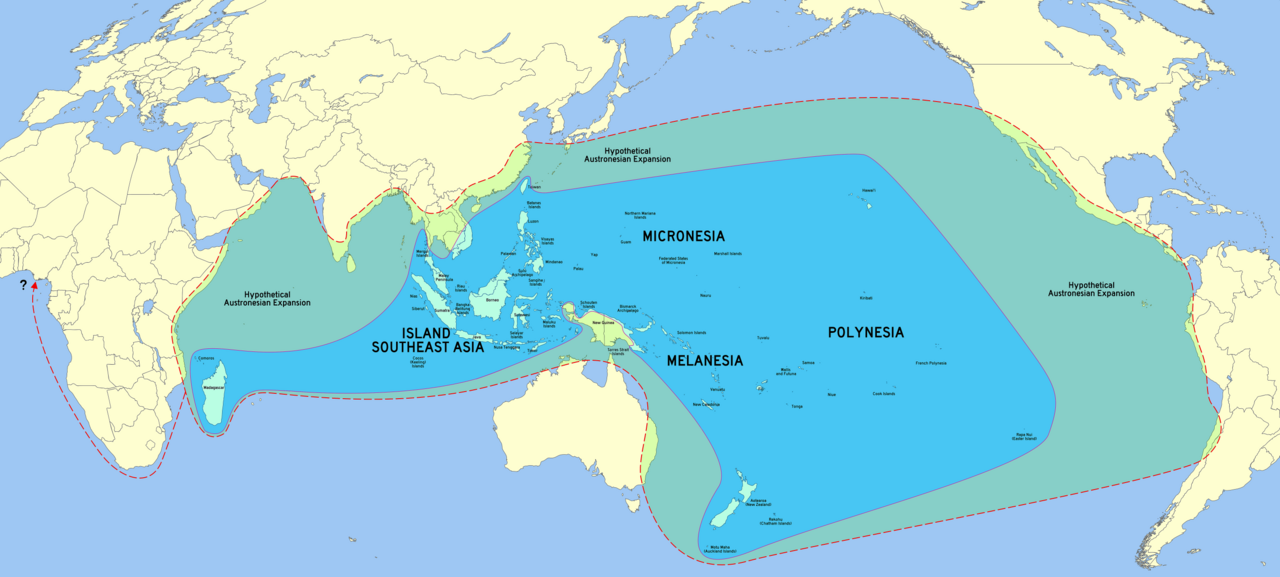
The Philippine module is more direct. In presenting Bellwood's Austronesian model, the Department of Education's Grade 5 social-studies material says that Austronesian ancestors reached the Philippines around 2500 BCE "from Taiwan" (mula sa Taiwan), then traces further movement towards Indonesia, Malaysia, New Guinea, Pacific islands and Madagascar. It also introduces Solheim's Nusantao model, allowing pupils to compare explanations rather than treating one origin story as untouchable. The Batanes archaeological sequence independently supports the southward direction from Taiwan through the Philippines. 8,3
Thailand answers a different layer of the question. Its official Grade 5 history lessons do not adjudicate Austronesian origins; they ask pupils to analyse Indian influences on writing, law and religion, and Chinese influences on language, religion and food. Their stated goal includes recognising the multicultural character of Thai society. Thai education can therefore describe national culture as a product of contact, selection and adaptation without requiring an unchanged, pure ancestry. 4,5
Indonesia and the Philippines share the most direct Austronesian linguistic history with the Malay world. Thailand borders the peninsula and has long participated in the same mainland-maritime exchange system. These classrooms do not replace archaeology; they reveal a more natural national narrative: ancestors move, languages change, cultures meet, and present-day citizens still belong to their countries.
Why "Indigenous" Becomes Political in Malaysia#
Among these four countries, Malaysia does present an unusually strong institutional contrast.
It would still be indefensible to write that "only Malaysian Malays claim to be indigenous". Many states debate first peoples, majority nations and land rights. What is distinctive in Malaysia is that Malay/Bumiputera identity is tied not merely to memory but to constitutional special position, public service, education, permits and later economic policies. Article 153 also protects the legitimate interests of other communities. Article 160 defines a Malay through Islam, habitual use of Malay, Malay custom and specified birth or residence conditions. It contains no DNA test and no requirement that one's ancestors never migrated. 12,13
After the New Economic Policy, the identity acquired a larger institutional function. Malaysian historian Cheah Boon Kheng notes that Bumiputera and Malay are often conflated in political language. An IDEAS policy history shows how Bumiputera became central to state development and political power. The evidence therefore supports a precise conclusion: Malaysia's "sons of the soil" discourse is not only an account of prehistory; it is also a political language for distributing resources, organising coalitions and legitimising policy. 13,14
Three propositions must now be separated.
First, Malays have a long history and homeland on the peninsula. Migration science does not contradict this. Nearly every people formed through movement; centuries or millennia of life in a place can make a community inseparable from it.
Second, Malays are the peninsula's sole, pure and never-migrating first population. The Constitution does not say this, and linguistics, archaeology and DNA do not sustain it. Malay belongs to an extra-Taiwan branch of Austronesian; the Malayic homeland is often placed in western Borneo; and genomic studies find multiple ancestries and continuing admixture rather than a sealed lineage. 6,17,18,15
Third, because ancestors migrated, their descendants do not belong today. That is equally false. Science reconstructs population history; it does not issue or revoke a modern homeland.
The Austronesian map should therefore not be reduced to "Taiwan first, the Philippines second, Indonesia third and Malaysia last". Prehistoric routes predate national borders and branched, doubled back and mixed across Borneo, Sulawesi, Java, Sumatra and the peninsula. The mainstream evidence does establish something narrower: Taiwan and the Philippines sit near deeper branching points in Austronesian history; peninsular Malay is not the root of the whole tree. Only when a political slogan insists that Malay ancestors never arrived from elsewhere does it directly contradict Indonesian and Philippine materials and the linguistic-archaeological evidence. 1,6,7,8,3
Thailand likewise cannot be described as one uniform people moving south and wholly replacing earlier inhabitants. A more defensible account is that Tai-Kadai-speaking populations have deep links with southern China and expanded south, then mixed over long periods with earlier Austroasiatic and other communities in present-day Thailand. Thailand's official lessons consequently present society as culturally plural, a better fit with population history than the idea of a people appearing from the soil without movement. 4,5,19,20
One longer arrow remains.
If we accept the basic framework of modern anthropology and genetics, the deep origin of Homo sapiens lies in Africa, followed by dispersal into Asia and the rest of the world. No modern people can therefore turn "our ancestors never migrated" into a scientific certificate of purity. The answerable questions concern when migration occurred, where languages and cultures formed, and how newcomers mixed with earlier populations. A modern political identity cannot be projected backwards as prehistoric biology. 16,15,19
Four Theories, Four Different Questions#
Many arguments never end because four answers are placed under one question.
Out of Africa asks where Homo sapiens ultimately expanded from, on a timescale of tens of thousands of years and more. 2,16
Out of Taiwan asks how Austronesian languages and associated Neolithic populations spread through the Philippines into maritime Southeast Asia about four to five thousand years ago. 6,7,8
The Yunnan theory, familiar from older textbooks, describes direct movements from the mainland in two waves labelled Proto-Malay and Deutero-Malay. It recognizes real connections between mainland Asia and the islands, but compresses a long, complex history into two columns marching out of Yunnan. 1,2
The Nusantara homeland or Out-of-Sundaland model emphasizes deep local ancestry in the islands and on the submerged Sunda Shelf. Its warning is valid: migrants from Taiwan did not arrive on empty islands. But "people were already here" cannot by itself explain why the deepest divisions of the Austronesian language family are concentrated in Taiwan. 6,9,10
Out of Africa is therefore not the enemy of Out of Taiwan, and local continuity is not the opposite of migration.
They illuminate different layers of time.
Why Out of Taiwan Leads#
The first pillar is language.
In Blust's higher-order classification, Austronesian has at least ten primary branches, nine of which are represented only among Taiwan's Indigenous languages. Nearly all of the roughly 1,200 Austronesian languages beyond Taiwan, including Malay, fall into the remaining Malayo-Polynesian branch. Dense branching near the root usually indicates that a language family remained and diversified there for longer. A computational study of four hundred languages likewise placed the origin in Taiwan about 5,200 years ago. 6,7
The second pillar is archaeology.
Pottery, farming assemblages and maritime technologies from Taiwan through the Batanes and northern Luzon, then onward into the Indonesian islands, show a broadly north-to-south chronology. No artefact automatically identifies the language of its maker, but the sequence and direction broadly agree with the language tree. 7,8
The third pillar is genetics.
Modern and ancient DNA identify ancestry contributions related to Taiwan and the Philippines. Yet the genetic account is one of mixture, not replacement. Migrants met earlier inhabitants and mixed with them to different degrees on different islands. Papuan-related ancestry generally becomes more prominent toward eastern Indonesia, while some regions also carry contributions related to mainland Southeast Asia. 9,10,11
The three disciplines do not speak exactly the same sentence.
But they broadly point the arrow in the same direction.
That is why Out of Taiwan currently leads.
Why the Other Models Are Less Secure#
The main weakness of the Yunnan theory is that its geography is too broad and its route too straight.
Southern China and mainland Southeast Asia may well preserve a deeper prehistory of populations ancestral to Austronesian speakers; Taiwan's Neolithic inhabitants did not descend from the sky. But "deeper ancestors once lived in southern China" is not the same proposition as "Proto- and Deutero-Malays migrated directly from Yunnan into Indonesia in two waves". The latter struggles to explain the nine primary language branches in Taiwan or align fully with the Batanes–Luzon–archipelago chronology. 6,7,8
The main weakness of an exclusively local model is that it turns "genes have been here for a very long time" into "the language must have originated here too".
Human ancestry in the Indonesian islands long predates the Austronesian expansion, and present-day people inherited much of it. But earlier inhabitants can adopt the languages of later arrivals, while newcomers can absorb local ancestry. Genetic and linguistic histories intersect without always overlapping. 9,10,11
Out of Taiwan did not prevail because it proved "pure blood".
It prevails because it currently explains the language tree and archaeological direction most coherently, with partial support from population genetics.
So Where Did the Malays Come From?#
The answers can now be restored layer by layer.
For the deepest ancestry of modern humans: Africa.
For the Austronesian language world to which Malay belongs: the mainstream model points to Taiwan, followed by a southward expansion through the Philippines.
For the smaller Malayic branch: linguistic debate often places its homeland in western Borneo, though questions remain.
For the early political-cultural centre called Melayu in historical sources: the clearest early evidence clusters in what is now southeastern Sumatra, around the Palembang–Jambi world.
For the formation of modern Malay society on the peninsula: add the peninsula's existing inhabitants, earlier Malayic-speaking communities, and later arrivals from Sumatra, Java, Bugis, Minangkabau and elsewhere. 6,17,18
These five layers do not cancel one another.
Nor should they be compressed into "the Malays came from Taiwan", as though one boat landed and a complete modern ethnicity stepped ashore.
A more accurate conclusion is: even if peninsular Malays and many peoples of the Indonesian archipelago are placed within one Austronesian history, what they share first is a history of migration, divergence and mixture, not a map proving that their ancestors never moved. 9,10,17,18
The Evidence for This Chapter#
The Indonesian education sources prove that migration is openly taught, not that public opinion is unanimous. We found no national survey that would justify writing "all Indonesians accept Out of Taiwan". 1,2
The Philippine module does teach the Taiwan route, but it also presents other models. This chapter uses the Department of Education resource for classroom content and Batanes archaeology to check the migration direction independently; it does not turn "a theory is taught" into "all Filipinos agree". 8,3
The Thai evidence concerns multicultural formation, not Austronesian ancestry. Official lessons teach long interaction with Indian and Chinese civilisations. This chapter does not use that evidence to claim that Thais endorse Out of Taiwan or to substitute cultural influence for genetic ancestry. 4,5
The leading position of Out of Taiwan comes from convergence across disciplines. Blust and Gray provide linguistic evidence, the Batanes research provides archaeology, and Lipson, Hudjashov and Oliveira provide genetic evidence. This chapter does not turn a language expansion into total population replacement. 6,7,8,9,10,11
The answer concerning Malays is deliberately layered. Adelaar is used for the Malayic linguistic homeland and Andaya for Melayu political-cultural identity; neither is treated as proof of a single biological ancestry for modern Malays. 17,18
This chapter is marked sensitive: true. Before publication, references to Malays, Orang Asli, Indonesian peoples, Out of Taiwan and "foreignness" must be reviewed line by line by the editor.
Sources 20 Every important claim here can be checked. Open it and see.
Do not trust this site. Check it — every source below is clickable.
This site is written with AI assistance. Please check us.
AI can invent citations that look completely convincing — a real author's name, a plausible title, a sensible year, for a work that does not exist. This is not a theoretical risk; it is a known failure mode. That is why every source on this site is clickable. If a reference cannot be found anywhere, it may well not exist — and we want to know.
How to check us →
Reader Comments
Be the first to share your thoughts.