The Legend of Hang Tuah, Part One: The Royal Command, the Brotherhood, and the Woman on the Mountain
A fictionalized narrative adapted from the Hikayat Hang Tuah, the Malay Annals, and folklore—not a strict historical account.
Draft — not yet fully checked.
This is not a history book.
This piece is a story, primarily for reading pleasure, intended to help readers enter the legendary world of Hang Tuah, Hang Jebat, Tun Teja, and the Princess of Mount Ledang.
It draws its material from the Hikayat Hang Tuah, the Malay Annals, and Malay folklore; these texts and studies form the skeletal framework of this narrative. 1,2,3,4
The port systems, monsoon trade, Bukit Cina (Mount Cina) legends, and multilingual background in the story borrow clues from Tomé Pires, studies on the Melaka harbormaster (Syahbandar) system, and later popular materials. 5,6,7,8
The Chinese accountant, Chen Guan, is a fictionalized composite character based on memories of the Chinese community at Bukit Cina, the maritime trade between Melaka and the Ming Dynasty, and the world of port interpreters; his family background, dialogue, and friendship with Hang Tuah are not verbatim historical records. 5,6,8,9
The sections where Chen Guan speaks of Wang Dayuan and Yijing borrow from the 14th-century records of Temasek/Singapore in the Daoyi Zhilue, and Yijing's 7th-century maritime Buddhist route via Srivijaya, respectively. This text logically imagines Hang Tuah meeting Chinese merchants and Buddhist figures in the port of Majapahit based on this, though it does not claim Yijing himself visited Majapahit. 10,11,12,13
For Tun Teja's segment, the story adopts the tradition that "she was the daughter of the Bendahara of Pahang, later brought to Melaka"; different texts vary on details, and the tokens, dialogue, and family negotiations presented here are novelistic additions. 14,15
Mentions of Hang Nadim saving Temasek, the strongman Badang, and the divine weapon Taming Sari belong to a shared legendary world found in the Malay Annals, the Hikayat Hang Tuah, and later folklore; this text utilizes them as literary material—things the characters heard, comparisons made by onlookers, and elements of Hang Tuah's early fame—rather than historical events to be cross-examined verbatim. 1,2,16,17,18
The segment on the Princess of Mount Ledang also references the modern atmospheric treatment in the 2004 film Puteri Gunung Ledang: echoes of the Java/Majapahit court, the backdrop of war, the mountain's mystique, and the theme of "personal affection crushed by the kingdom's interests." This text does not adopt the film's main romantic plot, its cursed ending, or specific scenes, but borrows its broad elements to enrich the scene's texture. 19,20
The layer involving the mountain people of Mount Ledang borrows clues from later narratives connecting the Gunung Ledang legends with the Banuas, Orang Benua, Orang Asli, mountain magic, and ancient mountain dwellers. This text does not explicitly identify the Princess of Mount Ledang with any modern ethnic group, but simply uses details like the language barrier, knowledge of mountain paths, gathering of water and herbs, and silent communication to depict that she is accompanied by ancient mountain dwellers who do not belong to the linguistic world of the Melaka royal court. 20,21
The character Nina Chatu at the end, and the explanation in Portuguese materials that Lassamane / Laksamana means "Admiral of the Sea," are drawn from studies of Portuguese Melaka and Portuguese texts. 22,5,23,24
The dispute between Nina Chatu and the Hindu temple is a fictionalized composite episode created for this text to illustrate the relationship between the Indian merchant community and royal power; it borrows from Nina Chatu's identity as a Hindu merchant, clues about the South Asian merchant community in Melaka, and the historical context where 16th-century Keling/Tamil merchants still petitioned the Portuguese King with a collective voice. However, the specific plot of "a certain temple being forced to relocate" is not a verbatim record from extant historical materials. 22,23,25
Nina Chatu's defence in the fall-of-the-city scene is a fictionalised construction. It draws on three layers of historical clue: the undignified founding version in the Pires tradition, in which Parameswara killed Temagi at Temasik; the theme in the Sejarah Melayu narrative in which injustice and betrayal inside the palace bring the kingdom down; and the background in Portuguese materials of Utimutiraja and outside merchants who cooperated with, or repeatedly switched sides toward, the Portuguese during the city's fall. This text does not treat that speech as Nina Chatu's original historical words. 2,5,23,24
The Portuguese siege of the city references public narratives of the 1511 capture of Melaka: Afonso de Albuquerque's fleet, intelligence from the imprisoned Portuguese Rui de Araújo, Nina Chatu's mediation, the Melaka River bridge, war elephants, Chinese merchants providing ships, artillery fire, and the second general assault. 23,24,26
The paragraph on Nina Chatu's assessment of the Portuguese also references the fact that the Portuguese had previously established bases in Cochin and conducted military operations in Calicut and Goa, as well as Albuquerque's Indian Ocean policy centered on fortresses, settled populations, and control of trade routes. 26,27,28
Sultan Mahmud Shah's retreat south after the city fell, his subsequent resistance against the Portuguese in places like Bintan, and historical clues about Melaka receiving investiture and sending tributes to the Ming court in its early years are referenced from summaries of Mahmud Shah's biography and materials from the Ming Shilu. The city-fall speech arranged in this text is a novelistic reconstruction based on these clues, not a verbatim historical document. 9,29,30
The assertion that a group of elite Muslim merchants left Melaka in the early Portuguese period, damaging the scale of port commerce, references secondary overviews like the World History Encyclopedia; this text incorporates this point into the evacuation scene, though the specific characters and dialogue remain literary treatments. 23,31
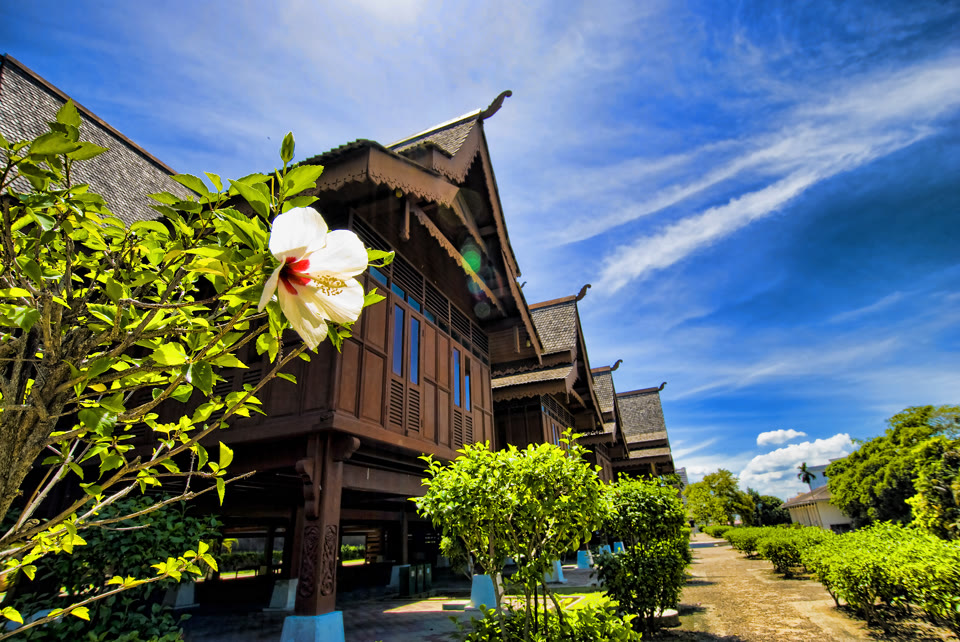
Clothing, court artifacts, and ceremonial gestures reference traditional Malay dress, baju kurung / baju Melayu, destar, kain samping, keris, and later reconstructive clues like the Melaka Sultanate Palace Museum; where there are no direct records of individual attire, this text offers only literary reconstructions. 32,33,34
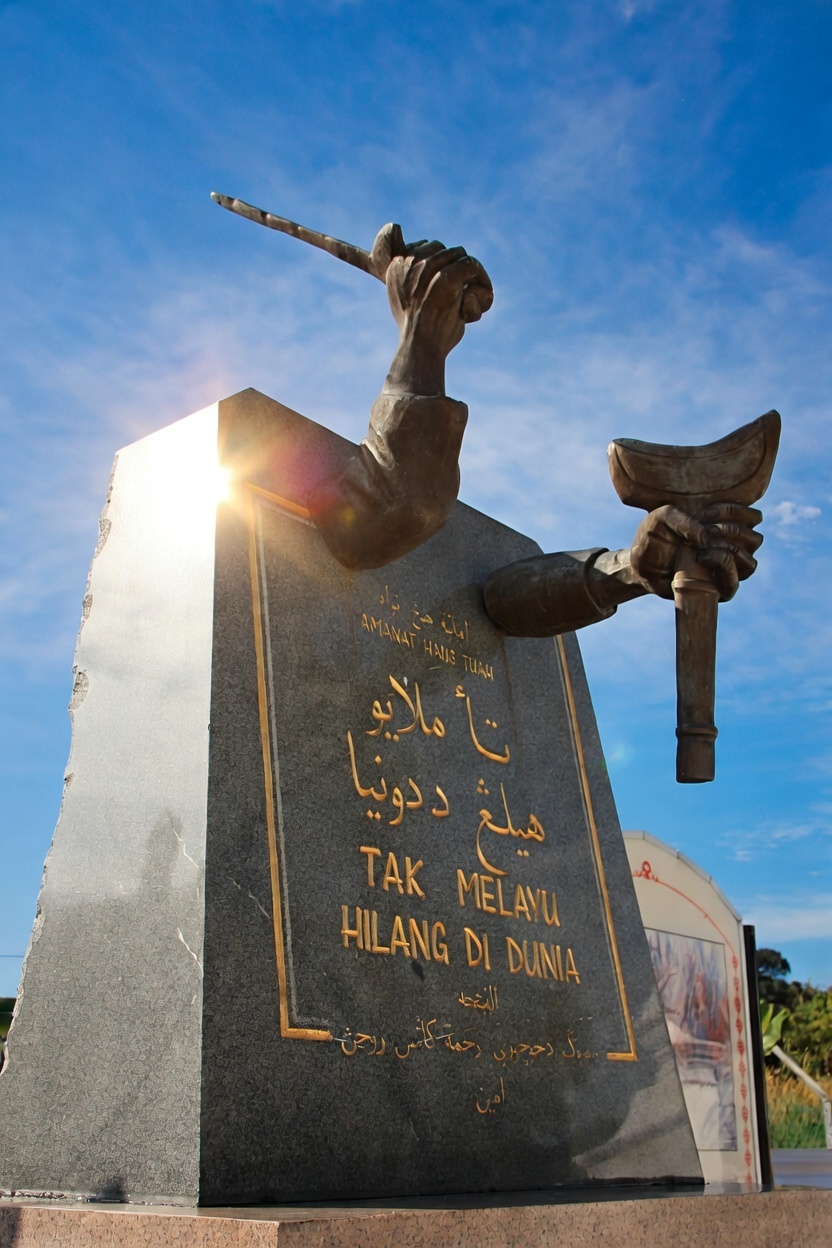
As for the phrase "Takkan Melayu hilang di dunia," later generations often attribute it to Hang Tuah, though the evidence for it as a historical quote is not robust. This text still places it in the final battle scene because what is written here is how a legend becomes the backbone of a people, not a verbatim recording of a battlefield.
If you are looking for historical research, please read the previous piece first: Who Was Hang Tuah? Five Brothers, Loyalty, and a Contested Hero.
If you are willing to listen to a story first, then let us begin by the sea.
I. Five Children by the Sea#
Melaka was still young then.
When the sun emerged, the harbor was full of fragmented, golden ripples; by night, the docks still found no rest. The chants of unloading cargo had ceased, but the myriad accents in the taverns continued to rise and fall.
Sea vessels chased the monsoons, entering the port wave after wave. When the northeast wind blew, ships from the east docked; when the southwest wind turned, sails from the west blanketed the sea. Textiles, ceramics, spices, and ledgers were carried down from the holds, and stepping ashore with them were voices from every corner of the earth.
Those on the docks needed only to look up to see the world stepping down from the gunwales.
When Gujarati merchants disembarked, they first sought the Syahbandar who managed their side. Merchants from the Coromandel Coast, from Bengal, and from Pegu each had their own avenues. Sailors from Java, Maluku, and Palembang reported to another side; while ships from the Ming Dynasty, Ryukyu, Zhangzhou, and Champa went to find yet another overseer. 5,6,7
What did the children know of these rules? To them, the market was simply like a cast net; once a person stepped in, their ears were immediately entangled by a hundred different native tongues.
In the early morning, the fishmongers called out prices in Malay. Nearby, spice merchants haggled, mixing Tamil and Malay. Further along, some spoke Gujarati, some Javanese, some Zhangzhou dialect.
Once, the five children crouched by a fabric stall, watching a foreign sailor argue over the price with a local broker.
The sailor couldn't understand the broker's words, his face flushing with anxiety as he pointed to the fabric and then to his coin purse.
The broker smiled, said it once in Malay, and then switched to a broken, half-baked Tamil. An old man nearby, growing impatient, helped him out by adding a few sentences in Javanese.
The sailor was stunned.
"How many languages do you people speak here?"
The broker shook out the cloth like unfurling a small flag.
"Our Melaka?" he said. "We have all eighty-four."
The children heard this and all looked up.
Whether eighty-four was true or false, the children had no way to tell. But standing in that clamor, there truly were countless rivers of speech flowing past their ears, sometimes colliding, sometimes converging into one. 5,6
Back then, when adults spoke of people, they didn't pigeonhole them into modern racial grids.
They would say: That is a shipowner from Java. That is a sailor from Palembang. That is a Muslim merchant from Pasai. That is a Keling merchant. That is the accountant from the Chinese ship. That is a local who has lived by the mountain for a long time.
Behind every title trailed a path of origin, carrying the dust of the sea. The people of that time had not yet been filed into the neat compartments of later registers.
At the end of the market, heading further up the hillside, one could see people carrying water, growing vegetables, and drying cloth.
One time, Hang Lekiu chased a rolling copper coin to the foot of the slope and nearly knocked over the water bucket of an old Chinese woman.
The old woman scolded him; he didn't understand, but he knew they were not kind words.
A local nearby smiled and helped him out:
"Don't be angry with the child. People here at Bukit Cina have always had to learn how to bicker with the children from the port."
"Bukit Cina?" Hang Lekir asked.
The man pointed up the slope.
"Some say the people of the Great Ming princess once lived there. Whether it's true or not, you can ask the elders when you grow up. All we know is that people grow vegetables on the mountain, there is water in the wells, ships come and go, but people slowly stay."
Hang Tuah listened without interrupting.
Jebat, however, asked:
"What if someone says they shouldn't stay?"
The local looked at him.
"Then we'll see who dares to drive them off the mountain."
Jebat immediately smiled.
Hang Tuah, however, did not smile. He glanced at the vegetable plots and bamboo drying racks on the hillside, tucking that sentence into his heart. In Melaka, staying wasn't difficult; but making others acknowledge that you were now of this place might take more than just a pair of hands. 2,8
The one who had helped the old woman right her bucket that day was a thin Chinese youth.
He could speak Malay, but his intonation carried the inflection of the lands across the sea. Others called him Ah Guan; the people in the counting house called him Chen Guan. His father had come to Melaka with the Chinese ships, later falling ill before the monsoon turned, and had no choice but to settle by the mountain. His mother mended clothes for others, while he went to the port by day to read and keep accounts for people, and by night, he still read a few pages of old books with the elders on the mountain.
Seeing him bend down to pick up the copper coin, Jebat asked:
"You live at Bukit Cina too?"
Chen Guan nodded.
"Live here long enough, and the mountain recognizes you."
Hang Lekiu laughed at him:
"A mountain can recognize people?"
Chen Guan set the bucket back by the old woman before turning to say:
"Don't you people by the sea also say that the tide recognizes the path?"
Hearing this, the children found the words a bit strange.
Only Hang Tuah gave him a second look.
Only later would they realize that Chen Guan was familiar with far more than just mountain paths. He knew ledgers, recognized the characters brought by the Chinese ships, and had read old words that adults refused to speak plainly in public. Years later, as Hang Tuah stood between royal command and human lives, the voices heard at the foot of Bukit Cina would cross the long years to return to his heart.
Hang Lekiu loved the market most.
He would squat before the fabric stalls of the Indian merchants, using half a sentence of Malay and half a sentence of some dialect he picked up from who knows where, stubbornly bargaining down a piece of blue cloth by two coins. The merchants, well aware he was feigning pity, were nonetheless amused and would wave him away, yielding to his price.
Hang Lekir liked watching the scales.
He loved watching merchants pour spices into the copper pans, adding and removing weights until the scale balanced. His later extraordinary eyesight was trained inch by inch in the market: exactly how much a pinch of pepper fell short, whether a handful of rice had caught dampness, and whether the mud on a ship's rope was from the river or the sea.
Hang Kasturi liked mingling with the sailors.
He listened to sailors speak of the waves of the Java Sea, the islands of Maluku, and their critiques of the ships: some were swift but couldn't withstand the wind; others looked clumsy but, when plunging into fierce waves, could surprisingly hold the water down.
Jebat didn't like to hear things out to the end.
Once, a foreign sailor, complaining the fish were too small, took the fish but refused to pay the full price. The old fishmonger grabbed his cuff, and the sailor shook his hand off, nearly pushing her over.
Jebat was the first to rush forward.
He had no sword, only a bamboo pole he had just bought. Tapping the pole on the ground, he had already placed himself in front of the old woman.
"Pay up."
The sailor couldn't understand him, but he understood the look in his eyes.
He reached out to push Jebat, and Jebat seized his wrist. The grip was so heavy that the sailor bent over in pain, and the surrounding crowd immediately closed in. The Gujarati merchant's clerks shouted, the Javanese sailors shouted, and the fishmongers shouted even louder. The situation looked as if it would instantly erupt into a brawl between two groups.
Only then did Hang Tuah push his way in.
He didn't scold the sailor first, nor did he tell Jebat to let go.
He looked first at the fish on the ground, then at the sailor's coin purse, and then at the small scale by the old woman's bamboo basket.
"He's not refusing to pay," Hang Tuah said. "He thought this basket was the same price as the one from earlier."
The old woman grew anxious.
"It's not!"
Hang Tuah separated two fish, pointing them out to the crowd.
"This one is left over from the morning market. This one just came ashore. The price is different. The auntie didn't explain clearly, and he didn't understand."
These words offered the sailor a way out and gave the old woman face.
Hang Lekir quickly righted the small scale, and Hang Lekiu seized the moment to pick up the two fish, using exaggerated gestures to compare the large one with the small one. The crowd laughed, and half their anger dissipated.
In the end, the sailor gave a few more coins. The old woman accepted them, still muttering curses, but didn't press the matter further.
After Jebat let go, he said in a low voice:
"He was just bullying people."
"I know," Hang Tuah said.
"Then why did you speak up for him?"
"I wasn't speaking up for him," Hang Tuah said. "I was leaving him with no reason to call his shipmates to draw their swords."
Jebat remained unconvinced.
Hang Tuah added:
"You can beat him. But you can't beat the whole ship."
Jebat looked at him, and for the first time, did not immediately talk back.
At that time, Jebat held no official post, nor did he have a sword at his waist. But he couldn't stand seeing bullying; when he saw it, he had to intervene, even if it meant turning things upside down.
Hang Tuah was always one step slower to speak. He first looked to see who was lying, who was merely panicked, and then sought a path that would allow everyone to back down. It wasn't that his heart was colder than Jebat's, but that he had understood early on: in Melaka, one wrong word might startle not just one person, but a ship full of sailors, a warehouse full of cargo, or even a group of merchants across the sea.
Children growing up in such a place rarely learned just one skill.
The first thing Hang Tuah learned was this word: "Steady."
They fought too.
Sometimes in the back alleys of the market, sometimes on the muddy riverbanks, sometimes at the edge of the forest.
The forest wasn't far away. It was just outside the city. Running out from the port, the children could quickly smell the scent of wet leaves, roots, and muddy water. They made snares out of vines—originally just imitating the adults' crafts—but often ended up trapping their own feet.
Once, Hang Lekiu really did get snared.
The vine loop tightened, and he was left hanging upside down from a low branch, screaming in terror. Hang Lekir hopped around anxiously below, and Hang Kasturi drew a small knife to cut the vine.
Jebat cursed, grabbed the bending branch, and forced it down with brute strength.
The branch groaned under his weight.
"Cut it, quick!" he shouted.
But Hang Tuah pressed down on Hang Kasturi's hand.
"Don't cut it here. If you cut it here, he'll land on his head."
He moved behind the vine knot, felt for the strand bearing the tension, first had Hang Lekiu hug the tree trunk, and then slowly loosened the vine loop bit by bit.
By the time Hang Lekiu was back on the ground, his face was pale.
Jebat, sweating profusely, remained stubborn.
"I could have saved him too."
"You could," Hang Tuah said. "Except you'd have both come crashing down together."
Jebat glared at him.
Chen Guan was also there that day.
Beside him was a Chinese elder who often came to Bukit Cina to pray. Seeing the way Jebat had just bent the branch down, the old man smiled and shook his head.
"This child's bones are not like ordinary people's."
Hang Lekiu immediately asked:
"Like who?"
The elder said:
"Like Badang."
All the children had heard this name.
The strongman in the old tales of Temasek, whose strength was so great he could show off before the royal court, drawing everyone's eyes to himself. Some said he truly possessed divine strength; others said that as stories are passed down, a man's strength is inevitably exaggerated until it's as high as a mountain. 2,17
Jebat's eyes shone brightly as he listened.
"So I am Badang reincarnated?"
Chen Guan translated half of it for the elder, then added his own sentence:
"He says, maybe so. But if a strongman only knows how to use brute force, sooner or later the court will take him to put on a show for others."
Jebat didn't like the second half.
But Hang Tuah remembered it.
Hang Tuah showed the vine knot to Jebat.
"Next time someone comes at us with a rope, we don't necessarily have to see who's stronger. Look first to see which strand is taking the strain."
Jebat snatched the vine knot, tugged it twice, and couldn't pull it apart.
"Too much trouble."
Hang Tuah smiled.
"That's why it works."
They didn't start learning martial arts with real swords, either.
First, they learned how to stand.
How to step into the mud, how to lower the body, how to relax the shoulders, how not to reveal their strength in their hands prematurely. The master made them walk on the sand after the tide had receded; whoever left footprints that were too deep got their shins whacked with a bamboo twig. Because deep footprints meant an anxious heart, and an anxious heart turns slowly.
Only later did they learn the staff, the spear, the short blade.
People today easily call this kind of training Silat. Strictly speaking, the martial arts of fifteenth-century Melaka shouldn't be directly boxed into modern school names; a steadier phrasing would be: they practiced the close-quarters combat, footwork, grappling, and weapon skills of the Malay Archipelago world, which later generations would understand within the traditions of silat/pencak. To make it easier for readers to enter the story, we will refer to it here as Malay martial arts. 1,3
They used bamboo poles to practice the spear.
Jebat loved long weapons the most, simply because before the hands even reached, the sharp edge of intent had already arrived. When he moved, there was fire; the bamboo pole split the wind, aiming straight for a man's shoulder. Hang Kasturi was often forced back again and again, until he had nowhere left to retreat, at which point he would curse loudly.
Hang Tuah, however, was never in a rush.
He wasn't rushed when practicing the blade. Before striking, he first looked at the feet, the wind, and his opponent's eyes. He didn't care to be first. When the master asked who dared to go first, he always waited for the others to move. Only when the other person revealed a flaw did he step in.
Hang Jebat had a completely different temperament. If someone cursed him once, he had to return it twice; if someone merely touched their sword hilt, he was already standing in front of his friends. There wasn't a total lack of measure in his recklessness, but when it came to his own people being bullied, he could never endure it.
The master loved pairing the two of them to spar.
Jebat was strong; when the bamboo pole swept over, the wind arrived first. If Hang Tuah met it head-on, his arm would be numb for half the day. So he didn't meet it head-on. He retreated half a step, letting the bamboo pole brush past his cuff, then turned sideways to tap Jebat under the ribs.
Jebat never accepted it.
"Touching clothes counts as touching the person."
Hang Tuah said:
"Then you'd have been dead three times already."
The next time, Jebat didn't sweep; he pressed straight in. His shoulders were like door panels, forcing Hang Tuah against a tree in just a few steps. Hang Lekiu yelled from the sidelines:
"Tuah has nowhere left to go this time!"
Hang Tuah pivoted on his toe, stepped on a tree root, used that bit of elevation to flip to Jebat's rear flank, and tapped the bamboo pole lightly on the center of Jebat's back.
Jebat turned around, his eyes both annoyed and bright.
"You cheated using the tree."
"When you're in a fight, the tree is there too," Hang Tuah said.
They could never truly determine a victor. If it were a matter of strength and courage, the moment Jebat stepped forward, he crushed everyone's breath; if it were a matter of footwork, retreat, and timing of the strike, Hang Tuah always saw half a step clearer than anyone else.
Hang Kasturi had the fastest blade, Hang Lekir had the sharpest eyes, and Hang Lekiu laughed the most. The five of them skipped classes together, got scolded together, and compared footprints together on the mudflats when the tide receded.
One day, they swore an oath under a tree.
Not to the heavens, nor to the king.
They said to each other:
"If one of us falls into hardship, the other four shall not abandon him."
After the five youths spoke, they smiled at each other, believing this single sentence could be kept for a lifetime.
They did not know that the hardest time to keep an oath is not under a tree, nor by the sea, but years later, at the exact moment the royal command falls.
II. The First Pirates#
The names of the five youths first reached the royal palace because of a pirate raid.
That day, a ship was being chased outside the port. Merchants shouted, sailors shoved cargo boxes into the hold, and people on shore ran to alert the officials.
The five youths moved first.
Hang Tuah didn't board a ship immediately. He looked at the tide first.
The seawater was receding.
Outside the mouth of the Melaka River lay a stretch of shallow sand, usually hidden underwater. In the middle was a deeper channel; experienced merchant ships would follow this channel slowly backward into the river mouth. The water on the sides looked flat, but once the tide went out quickly, only a thin layer of water remained beneath the hulls.
Small boats could handle shallow water better than large ones, but men who chased with bloodshot eyes often failed to look beneath their feet.
To take a shortcut, the pirates refused to circle back to the deep channel. Seeing Hang Lekir and Hang Lekiu's small skiff skimming the edge of the shallow sand, they thought they could cut across too. The bow of their ship, like a tooth eager to bite, charged straight into the receding shallows.
Hang Tuah was waiting for exactly this half-quarter of an hour the tide afforded him.
Hang Jebat had already grabbed his spear.
"What are you still looking at?" Jebat shouted.
"Looking at how we make it back alive," Hang Tuah said.
Jebat smiled.
Hang Tuah didn't tell everyone to charge out to meet them.
He had Hang Lekir and Hang Lekiu row their small skiff out first, intentionally rowing erratically, like two terrified children. Seeing them, the pirates thought there were only youths on shore, and immediately split off one ship to chase them.
Hang Tuah stayed behind, tied two empty cargo barrels together with a rope, and sank them at the edge of the shallow sand. It wasn't to block the large ships in the deep channel, but to catch the bow of the ship chasing into the shallows. When the tide fell faster, the water pulled the rope taut against the mud, leaving only a faint wooden shadow visible on the surface.
"Now, run," he said.
Only then did Hang Jebat charge out.
Not a blind charge.
He charged straight at that pirate ship, cursing so loudly and viciously that he drew everyone on board to the bow. In the pirates' haste to turn the rudder, the stern was still in deep water while the bow plunged headfirst into the shallow sand. The rope beneath the mud tripped them violently, and the entire ship lay dead across the boundary of the deep channel and the shallows.
Before anyone could even find their footing, Jebat had already leapt aboard.
Hang Tuah boarded from the other side.
He didn't cut down the first man. He cut the sail ropes first.
Once the sail fell, the ship lost the wind. The second pirate ship tried to come to the rescue, only to find their comrades blocking the waterway horizontally, leaving them unable to advance or retreat. Only then did the sailors on shore dare to extend their long poles and push the merchant ship back into deep water.
When Jebat swung his spear, he first cleaved through the cowardice of the crowd; but before Hang Tuah even made a move, he had already calculated their survival into the tide.
After that battle, the Melaka royal palace heard their names for the first time.
Others only said that five youths had driven off the pirates. But when the Bendahara heard the tale, he asked about the child who had delayed boarding the ship. His victory didn't rely on hot-blooded courage, but on the receding tide, the direction of the wind, and the slight impatience of the enemy in pursuit.
When the Bendahara relayed this to the Sultan, the Sultan was looking at the tax ledgers sent from the port.
He didn't look up immediately.
"Relying on water, wind, and the enemy's impatience?"
He read the words slowly, his fingertip pausing on the edge of the ledger.
If a warrior only needed to ask who dared to advance, one could easily find many. But the throne of Melaka could not rely solely on the word "dare": ships must wait for the wind, merchants must keep their word, and the chaotic port required someone to rein it in. Those who dared to charge were everywhere; those who could make the enemy crash themselves into the shallows were rare.
Only then did the Sultan look up.
"Bring them into the palace."
The five youths were summoned to the court. From that day, the oath sworn by the sea began to walk toward the throne.
III. The Throne is High, the Shadows are Long#
The paths within the royal palace were unlike those by the sea.
If a person tripped on the beach, their knees coated in muddy water, everyone could see it. When someone lost their footing in the palace, it was often completely silent, and even the blood could be hidden deep within the felt carpets.
Hang Tuah was quickly noticed.
He understood etiquette, and he recognized the right moments. He didn't hesitate when it was time to speak, and he suppressed the fire in his chest when it was time to remain silent. The Sultan liked such subjects, and the Bendahara saw it even more clearly: this young man knew how to use a sword, and he also knew how to sheathe it.
Once, an envoy from Champa presented gifts in the great hall.
Halfway through reading the gift list, the translator suddenly stumbled. The quantity of cloth in one of the chests didn't match the number the scribe held. Everyone in the hall looked at the envoy. The envoy's expression changed, thinking the Melakans were publicly accusing him of shortchanging the tribute.
The Sultan frowned as well.
It wasn't that he didn't understand this kind of situation.
He understood it too well, which was why he was all the more annoyed in that instant. If he spoke too harshly, the Champa envoy would lose face; if he spoke too lightly, it would seem Melaka was afraid to audit its own tributes. Worse yet, several people in the hall had already turned their eyes to him, waiting to see how the king would mend this minor rift.
The Sultan's fingers gripped the armrest—gripped it so tightly that his gold ring struck the wood with a very soft clink.
The sound was fleeting.
But Hang Tuah heard it.
These small matters are the most dangerous. If pursued on the spot, the envoy loses face; if ignored, the court loses its dignity.
Hang Tuah spoke for neither side.
He simply stepped forward, bowed to the Sultan, and then turned to the envoy.
"The sea route is long, and the chests are many. Please allow me to register the gifts item by item on behalf of our guests, lest we in Melaka make a mistake in our own records."
With one sentence, he preemptively took the blame onto their own side.
The scribe breathed a sigh of relief. The envoy also had a way to step down gracefully.
When the chest was reopened, they found the cloth pressed beneath the second layer of wooden boards; nothing was missing.
The Sultan didn't praise him on the spot.
He only waited until the envoy withdrew, and asked one sentence:
"If a bolt of cloth truly had been missing just now, what would you have done?"
Hang Tuah replied:
"I would not ask in public. The Sultan's face is heavier than a bolt of cloth. After the guest leaves the palace, this subject would investigate privately."
The Sultan looked at him.
That gaze was different from when he first heard the story of the pirates.
Then, he appreciated a resourceful youth.
This time, he saw a different kind of capability: one that could simultaneously cover a moment of royal embarrassment, save face for a guest from afar, and yet not surrender an ounce of Melaka's rules.
Street smarts could save oneself; brought to the court, they could sometimes save a breath for the throne.
From that day on, Hang Tuah stood a little closer to the throne.
Hang Jebat was also noticed.
But the manner in which he was noticed was different.
When he stood before the hall, his eyes were too direct. When he heard unjust words, his face couldn't hide it. He disliked those who whispered in the Sultan's ear: one saying someone had rebellious intentions, another saying someone had taken a bribe, another saying someone had looked at a woman they shouldn't have.
Those people didn't like him either.
And they disliked Hang Tuah even more.
Because Hang Tuah was too close.
The place beside the throne is never left empty for a man without enemies.
The Bendahara warned him once later on.
The hall had just dismissed, Hang Tuah was still young, and his sleeves still carried the heat of having bailed out the king. The Bendahara did not praise him, only asked:
"Have you heard of that clever child in Temasek?"
Hang Tuah said he had.
Everyone by the sea had heard of it.
When swordfish attacked the coast, the king ordered men to form a wall of flesh to block them, and many died. Later, a child suggested: why not plant banana tree trunks along the shore so the swordfish's long snouts would get stuck? The plan worked, and the city was saved. But the royal court suddenly grew afraid: if such a clever child grew up to stand against the royal command, who could stop him? Thus, the child was killed in the night, and his blood flowed onto the hill; later generations called the place Redhill. In various versions, later generations often refer to this child as Hang Nadim. 2,16
The Bendahara said:
"In the royal court, being clever is not necessarily a blessing."
Hang Tuah bowed his head.
"This subject does not seek to show off."
"You had better not," the Bendahara said. "And do not let others think you are. If the one who saves the city makes the king feel overshadowed, merit will become a crime."
IV. The Blade of Majapahit#
Later, Hang Tuah truly went to Majapahit.
Not alone.
He went with the Melakan envoys.
By that time, Melaka had long ceased to be just a new port at the river's mouth. It sent envoys to pay tribute to the Great Ming, relying on the Ming court's investiture to establish its legitimacy; to the north lay the intimidating power of Siam, which allowed no one a moment's forgetfulness. The old tales of Temasek still circulated across the straits, while ships from Java, Palembang, Pasai, Ryukyu, and the Ming arrived daily. The more prosperous the port became, the less the kingdom could afford to lose face in matters of protocol. 5,6,9
Majapahit was certainly no ordinary neighbor.
It was the name of the old great kingdom of Java, a shadow in Melaka's founding memories that had overpowered Palembang and pressured Temasek. For Melaka to stand firm on the straits, it could not bow its head to this name; yet it could not turn a diplomatic occasion into a personal feud over a single breath of pride. 2,5,6
So before the envoys departed, the Bendahara said only one sentence to Hang Tuah:
"Over there, winning is not the hardest part. The hardest part is winning, and still leaving them a way to step down."
The court of Majapahit understood old protocol better than Melaka.
The wooden pillars in the hall soared high, coiled with fine carvings. The sound of gongs drifted closer from afar, filtering in layer by layer. The people at the banquet spoke unhurriedly, but their eyes were never idle, all sizing up the new upstarts from the straits: did they understand the old etiquette, and apart from gathering wealth, how much capability did they truly have to command authority?
Hang Tuah also saw many Chinese people.
Some were tallying goods at the port, some were bargaining for merchant ships, some had abacus beads hidden in their sleeves, and some had shaved their heads, worn old monks' robes, and were asking Javanese monks for directions near the Buddhist temples. It was the earlier Srivijaya that Yijing had visited, not Majapahit; yet since the Tang dynasty, monks traveling to India for the Dharma, merchants waiting for the monsoon, and interpreters who could write Chinese characters had always traveled from station to station along this maritime route. By the era of Majapahit, the Javanese court still possessed the old rites overlapping Shiva, Buddha, and local ancestral spirits, while the northern coastal port cities saw the activities of Chinese merchants and Muslim traders from the west. Seeing all this, Hang Tuah knew: Melaka was not the only port under heaven that accommodated many voices, and Majapahit was not a kingdom left with nothing but swords and an old name. 12,13
It was in front of such a hall that Taming Sari emerged.
In the legends, he was a warrior of Majapahit, and the master of that keris. Some said the blade was forged from multiple metals and harbored divine power; others said that half the blade's formidable presence came from everyone's unquestioning belief in it. 1,2,18
Taming Sari held the blade horizontally across his palm.
"The Laksamana of Melaka," he said. "Do you dare to try?"
The faces of some in the envoy party changed.
This was no ordinary sparring match.
If Hang Tuah retreated, Melaka retreated; if Hang Tuah killed, the face of Majapahit would also bleed.
If Jebat were there, he would surely have cursed first.
Hang Tuah, however, only bowed to the host, and then to Taming Sari.
"We may test our blades. We need not forge enmity."
Taming Sari smiled.
"Once a blade leaves its sheath, who cares about enmity?"
In the first exchange, Hang Tuah knew the legends weren't empty air.
That keris came in very strangely. It was unlike a long sword that opened and closed wide, nor like a short dagger that only struck close to the body. With a twist of Taming Sari's hand, the blade's gleam entered from unimaginable angles, like a gong strike abruptly cut off mid-beat.
Hang Tuah retreated.
Retreated again.
Smiles began to form on the faces of those in the hall.
They thought the warrior from Melaka was afraid.
In truth, Hang Tuah was watching.
Watching his feet, watching his shoulders, watching whether the tip of that keris revealed a hint of its direction before each strike. By the fifth exchange, Hang Tuah suddenly understood: Taming Sari trusted his blade too much.
Once a person firmly believes they can never lose, their flaw hides in the place they feel most secure.
In the sixth exchange, Hang Tuah deliberately yielded half a step.
Taming Sari gave chase, as expected.
If that strike landed, it would be enough to rip his belly open.
In the instant the blade's edge neared his lapel, Hang Tuah turned sideways to dodge it, his left hand pressing down on his opponent's wrist bone, his right hand's short blade flicking up from below. He didn't go for the throat, only the wrist. Taming Sari's hand went numb, and the keris fell from his grasp, landing between them.
The gongs in the hall stopped.
The legends say that the keris later went to Hang Tuah. Different versions tell it differently; some say the King of Majapahit rewarded him with it, others say it naturally fell into the victor's hands after the duel. Regardless, from then on, the name Taming Sari belonged not only to that Javanese warrior, but also to the divine weapon at Hang Tuah's waist. 1,2,18
But in this story, when the blade was handed to Hang Tuah, an old craftsman in the corner of the hall said a sentence.
The old craftsman's hands were covered in fire scars. How many blades those hands had sent out of the forge, and how many had later returned stained with blood, no one could clearly say.
He said:
"This blade protects the brave, and it also reflects the brave."
Hang Tuah looked at him.
The old craftsman continued:
"If you use it to kill the guilty, it clears the path for you. If you use it to kill the innocent, the heavens won't punish the blade first. The heavens will punish the king who commanded this blade to be drawn."
The history books did not record this sentence. It was a shadow added by later generations when they told the story, casting a pall over this blade.
But Hang Tuah heard it.
Years later, when he drew his sword in the royal palace to face Hang Jebat, this sentence would return from the depths of his memory. What is called a curse doesn't necessarily fall from the sky; it can also be that human hands stain themselves with blood, and then present it, inch by inch, before the throne.
V. The Bad Men Begin to Speak#
People in the palace gradually found a doorway: if they couldn't defeat Hang Tuah beneath the blade, they would defeat him in the Sultan's ear.
Today they said his royal favor was too great; tomorrow they said the five brothers were forming a faction; someone else sighed over Hang Jebat's fierce temper, fearing he would sooner or later stir up disaster. As for Hang Tuah, though his face was respectful, who could see if wild ambitions lay hidden in his heart?
Taken apart, these words were as light as willow catkins. But as they accumulated day by day, winding around a person, they became a silk thread that could cut a throat.
At first, the Sultan didn't believe it.
He had seen Hang Tuah save him from embarrassment in the hall, and he had seen Hang Tuah, during the duel, win over people's hearts before winning over his opponent's hands. If such a person had ambition, he should have long ago revealed an inch of greed.
So the Sultan only smiled.
"If Hang Tuah wants something, he will ask for it himself. He won't rely on you to speak for him."
Those presenting the advice bowed and withdrew, only to return another day with a different narrative. They no longer said Hang Tuah was disloyal; they only worried that he was too beloved by the people.
"Your Highness," someone said, "if such a person only speaks for the King, it is the King's blessing. But what if one day, people listen to him, and not to the King?"
This sentence never directly accused him of treason, yet it was more poisonous than speaking of treason plainly. It merely dropped a shadow into the Sultan's heart, and from then on, whenever the lamplight flickered, that shadow would grow of its own accord.
The second time someone brought it up, the Sultan did not smile.
He merely set his teacup down.
Before the tea was finished, the bottom of the cup struck the wooden table, the sound cut short.
The third time, when Hang Tuah entered the hall to report that a Syahbandar at the port had gotten into a dispute with a foreign merchant, the Sultan listened as usual, nodded as usual, but when Hang Tuah withdrew, his eyes lingered for a moment longer.
He saw the young attendants make way for Hang Tuah, saw two warriors salute Hang Tuah in the corridor, and saw that Hang Tuah knew exactly who was standing where without even turning his head.
These were originally the capabilities of a minister. But once doubt enters the sovereign's heart, strengths are inverted, becoming evidence of crime.
From then on, the way the Sultan asked questions slowly changed.
He used to ask:
"How do you think this matter should be handled?"
Later he asked:
"What do you think the people in the palace will say?"
And still later, he asked:
"If someone speaks in your name, would you know?"
Hang Tuah answered appropriately every time.
The more appropriately he answered, the less at ease the Sultan became.
A king doesn't necessarily fear a minister answering incorrectly. He fears more that someone always answers perfectly, as if they have calculated even the sovereign's heart down to the fraction of an inch.
Since the shadow of suspicion had been planted, there was no need to hastily launch the killing intent. If a king wants to tether a person, he need only tether the softest place in their heart.
Soon after, Hang Tuah's parents were brought into Melaka city.
The pretext sounded very nice.
The Sultan said that since Hang Tuah had performed meritorious service for the state, his parents should no longer live in an old house. The palace bestowed rice, bestowed cloth, bestowed a residence close to the royal city, and sent people to look after them daily.
Everyone said this was grace.
Only Hang Jebat, upon hearing this, let his face darken.
"Look after?" he said. "Or watch over?"
Hang Tuah didn't answer.
His parents were now secure in food and clothing, and he should have been grateful. Yet every time he was ordered out of the city, thinking of those two elders still remaining in the royal city, he knew what was tied to the other end of that grace.
The Bendahara had warned Hang Tuah.
"In the palace, not all swords are worn on the waist."
Hang Tuah replied:
"I only guard the royal command."
The Bendahara looked at him for a long time.
"Those who only guard the royal command fear nothing more than the royal command being wrong."
Hang Tuah didn't respond.
He was still young then, believing that a loyal heart stood so upright that no storm could snap it.
That night, he did not return to his parents' new residence.
He detoured to the foot of Bukit Cina.
There were few lights in the houses by the mountain, but Chen Guan was still awake. Ledgers were spread out on the table, Malay words on one side, Chinese characters on the other, pressed down by a few pages of a book weathered by the sea breeze. When Hang Tuah stood outside the door, Chen Guan was grinding ink.
"The Laksamana comes in the middle of the night—is it to audit my books?" Chen Guan asked.
Hang Tuah said:
"I want to ask about the matters in the old books of the Central Plains."
Chen Guan set down his brush.
"Ask about ships, about tea, about porcelain, or about the Emperor?"
Hang Tuah paused for a moment.
"Ask about sovereign and subject."
Chen Guan did not smile.
He trimmed the lamp wick brighter, and the ink on those few pages of old books in the room stood out.
"In the old books of the Central Plains, when they speak of sovereign and subject, they speak very heavily," he said. "A subject serving a sovereign must have propriety; a sovereign employing a subject must also have the Way. It's not that the world is at peace only when the subject kneels."
Hang Tuah asked:
"And if the royal command is wrong?"
Chen Guan looked at him.
"There is a saying in our books. When I memorized it as a child, I didn't understand it. Later, watching people make a living in Melaka, I slowly began to understand a little."
He dipped his finger in clear water and wrote on the table:
The People.
The State.
The Sovereign.
The water marks quickly spread.
Chen Guan said:
"Mencius said, 'The people are of supreme importance; the altars to the gods of earth and grain come next; the sovereign is of the least weight.' The meaning isn't to tell people to slight their lord; it means a sovereign is a sovereign because he must protect the people, and protect the state. If only the face of a king remains, while the commoners are trampled into the mud, and the state is dragged into the fire, then the roots and branches have been inverted." 35,36
Hang Tuah said in a low voice:
"In Melaka, if a subject said this, he would be deemed disloyal."
Chen Guan wiped away the water characters on the table.
"Perhaps. But my father said, on a ship, the most important thing is not the shipowner's face, it's that the ship doesn't sink. If the shipowner steers wrong for the sake of face, shouldn't the man at the helm still watch out for the reefs?"
Hang Tuah didn't answer.
Hang Tuah made no reply, merely gazing at the three water characters slowly drying on the table: the People, the State, the Sovereign.
A single night's conversation naturally could not suddenly turn him into a different person. The royal command remained as heavy as an iron seal in his heart, but beside that iron seal, three faint water marks were left behind from then on.
Before leaving, Hang Tuah asked again:
"Do you people of Tang also know the old tales of Temasek?"
Chen Guan pulled out a well-worn, copied page from a pile of books.
"My father said, during the Yuan dynasty, there was a seafarer named Wang Dayuan. He visited many islands and ports, and later wrote the Daoyi Zhilue. When he wrote about Temasek, he didn't just speak of myths and monsters like the storytellers; he also wrote about city gates, the harbor mouth, pirates, and warfare."
Hang Tuah stopped in his tracks.
Chen Guan said:
"He remembered there was a Dragon's Tooth Gate (Long Ya Men) there, and he remembered the Siamese came to attack. The people in the city shut the gates and held them off, resisting for a long time, about a month. You see, Temasek isn't an empty name. It has gates, people, fear, and defense." 10,11
Hang Tuah thought of the clever child the Bendahara had mentioned, and thought of the swordfish and Redhill.
"You mean to say, beyond the stories, there are people who wrote it down."
"Yes," Chen Guan said. "The storytellers record the people's grievances, the seafarers record the city's gates. Only when the two scrolls are put together does an old city truly have flesh and blood."
Hang Tuah asked no more.
As he walked down Bukit Cina, the weight of Temasek in his heart was different from when he arrived. There wasn't just a clever child killed on Redhill; there was once a month where gates were shut tight, and commoners held off the enemy. Cities on the straits rise and fall, and the stories left behind often secretly light the way for those who come after.
VI. The Woman from Pahang#
Later, the name of Tun Teja reached the palace. It wasn't written on a memorial; rather, as a night banquet was dispersing, a merchant returning from Pahang casually mentioned it.
A merchant returning from Pahang said there was a woman in the Bendahara's household there who didn't rush her curtsies, didn't show timidity when she spoke, and could even reject someone as smoothly as offering tea.
Someone in the palace smiled and chimed in:
"If such a woman were to enter Melaka, she would be truly fit to sit beside His Highness."
The Sultan was holding a piece of fruit in his hand at that moment.
Hearing this sentence, he didn't eat it immediately.
He merely turned the fruit around, as if examining its color.
"What is her name?"
"Tun Teja."
The stories said she was beautiful, and possessed insight; she was not a woman who could be coaxed away from her homeland with just a few words.
But the Sultan wanted her all the same.
And so, Hang Tuah was sent.
When the Sultan sent him, his mood was still good.
He hadn't completely viewed Hang Tuah as a dangerous person.
Not yet.
He still felt this matter required Hang Tuah. If anyone else went, they would be too crude; if Jebat went, his edge would be too sharp. Only Hang Tuah, in his advances and retreats, most resembled the decorum Melaka ought to have.
Yet behind this thought followed another.
A man being cautious in the royal palace is nothing rare.
If he left Melaka and traveled to a distant place, where he was no longer surrounded by familiar floorboards, familiar gazes, and familiar etiquette, would he still be as cautious?
If a woman truly trusted him, would he hide that trust in his own sleeve?
But a king's good intentions, resting on a subject's shoulders, weigh heavily.
Before departure, the Sultan didn't pressure him in front of the assembled ministers. That would be too crude, and unlike a man who sat securely on a throne.
The Sultan only had him brought to a side hall, where there was no drum music, only two lamps.
"Are your parents accustomed to living here?" the Sultan asked.
"Thank you, Your Highness, for your care."
"That is good. With the elders in the city, We are at ease. When you are out on affairs, you need not worry about your home."
Hang Tuah knelt.
He understood.
There wasn't a single word of threat in those sentences, yet they were harder to refuse than a threat. The more dignified the grace in the palace, the tighter the knots tied around a person often became.
The Sultan added:
"Some in the court say you are too good at making people believe you. We do not believe them. Bring Tun Teja back, and you will make them shut their mouths."
Having said this, as if just remembering, he turned his head and instructed:
"Let Awang go with you. A young man should see the roads outside, and he should learn how the Laksamana handles affairs."
These words were spoken gently.
So gently that no one could call it surveillance.
As Awang knelt to give thanks for the grace, the Sultan looked at the back of his neck.
"The matters on the road—when you return, tell them to Us as well."
Therefore, this journey to Pahang was not only to fetch someone for the Sultan, but also to maintain, for himself, his parents, and the city he was willing to protect with his life, a system of propriety he firmly believed in at the time: the superior commands, the subordinate obeys; states interact with etiquette, and the royal court must not easily tear away its face.
Among the entourage was a young attendant named Awang.
Awang was not inherently wicked, he just wanted the palace to notice him too badly. And he was too young to distinguish between the fine line of "learning" under orders and "reporting" in secret, or when that thread would wear down into the edge of a knife.
He followed Hang Tuah all the way to Pahang, watching how Hang Tuah opened his mouth, and how he stopped at exactly the right moments, making the listener forget the royal command behind him, feeling only that they were still being respected.
This time, he couldn't rely on a sword.
He carried gifts and words, walking into a place that didn't belong to Melaka.
The attendants carried cloth.
Not just any cloth.
In the caskets were fine cotton and colored threads from afar, and a length of gold-woven kain songket. Gifts have their own language: the softer the cloth, the less harsh the visitor's words can be; the more dazzling the gold thread, the more comprehensively the requested matter must be concealed.
Tun Teja was not a woman without a background.
Following the version of the legend adopted in this piece, she was the daughter of the Bendahara's household in Pahang, having grown up amidst pedigree and propriety from a young age. Her marriage was never just about herself; it was tied to her father's dignity, the etiquette between Pahang and Melaka, and even the future peace of the two royal courts.
So when Hang Tuah entered the door, he didn't see her first.
He first met the elders of her household.
The gifts were laid out, and the words were spoken very slowly. No one said the four words "The Sultan wants her" too directly. Nor did the people of Pahang refuse on the spot. To refuse too harshly was like throwing Melaka's face to the ground; to agree too quickly looked as if they were rushing to give their own daughter away.
An elder looked at that length of kain songket with gold threads, and after a long while, said:
"Laksamana, you come from Melaka, you should understand the weight of pedigree. She is not a flower in the market to be plucked just because someone likes it. She is the daughter of the Bendahara's house. For every step she takes, Pahang takes a step with her."
Hang Tuah bowed his head.
"This subject understands."
"It is good that you understand," the elder said. "A person who understands will not speak too fully."
In the end, the elders only said:
"Let her hear what kind of place Melaka is."
This sentence was very light.
But the door had been opened.
When Hang Tuah met Tun Teja, he didn't speak of the royal command. He spoke of the sea, the port, the lamps of Melaka that didn't extinguish at night, and how a city managed to make so many people from distant lands stay.
He didn't promise love.
He hadn't lied to that extent.
Yet he left blanks everywhere he spoke, and as Tun Teja listened, she filled them in with her own hopes.
Tun Teja listened.
In her eyes, the man before her gradually seemed less like an envoy of the Sultan. He knew how to sheathe his edge, and after finishing a sentence, was willing to stop and wait for her answer; it was as if, as long as she followed him, she could step off the path that had long been arranged by her family.
She was dressed very properly that day.
Long sleeves covering her wrists, the garment loose but not clinging, the color of the cloth not bright, yet revealing fine patterns when she turned. The kain at her waist was folded straight, a hairpin pressing down her chignon, not letting a single strand of hair fall out of place. Such attire was not meant to stun people.
It was to let people know: she came from a home where she was taught etiquette, a home with pedigree and pride.
She was not impolite.
She didn't laugh loudly in the corridor, nor did she ask explicit questions in front of her maids. She merely pushed her teacup forward gently, the sound of her questions low and steady. The upbringing she had received since childhood was entirely evident in this single push and question.
She asked:
"You came—for whom?"
Hang Tuah lowered his head.
"To take you to Melaka."
This was the truth.
But not the whole truth.
Awang was standing in the corridor.
He heard that sentence, and he saw the look in Tun Teja's eyes as she looked at Hang Tuah.
When he returned to Melaka, he would tell this scene to others. The first time he told it, he only said: "She trusted him very much."
The second time he told it, it became: "The way she looked at him wasn't how you look at an envoy."
By the time it was told a third time and reached the ears of the bad men in the palace, it became: "While in Pahang, Hang Tuah had already won her heart first."
Slander doesn't necessarily start with lies. The hardest thing to guard against is precisely the truth that stops halfway through being spoken.
VII. The Truth on the Ship#
Only after the ship heading back left Pahang did Tun Teja slowly come to understand: she was not traveling far with Hang Tuah, but being escorted by him to become the Sultan's woman.
By the time she understood, her homeland's shores had already receded to the edge of the sky and water.
She remembered how, before she left, her father hadn't looked at her for too long. When her mother straightened her collar, her fingers paused for a moment before continuing to smooth out the pleats. Her family didn't know absolutely nothing.
They knew Melaka's intentions.
They also knew that if they were going to refuse, they should have refused the day Hang Tuah walked through the door. Once she boarded the ship, the refusal was no longer just a woman's sentiment, but would become an embarrassment from Pahang to Melaka.
The ship's cabin was very quiet.
Outside, men were taking in the sails, boiling water, laughing. She sat in the shadows, looking at Hang Tuah.
She didn't ask about love first.
She asked about the path.
"If I want to return to Pahang now, will the ship turn back?"
Hang Tuah did not answer.
She asked again:
"If I arrive in Melaka and say I am unwilling, who will listen?"
Hang Tuah still did not answer.
Tun Teja nodded. She had asked twice; the silence had said all there was to say.
The ship had left the shore. Her attendants were on board. If Pahang's people gave chase, it would also turn into an embarrassment for both royal courts. If she threw herself into the sea, it was capriciousness; if she cried and made a scene, it was a breach of etiquette; if she arrived in Melaka and then refused, it would be dragging her own family into the Sultan's wrath.
It seemed there were many paths laid before a woman, but looking closely, the only one that would allow her and her family to walk away alive was the one right in front of her.
"If I had known from the beginning," she asked, "would you still have been able to take me away?"
Hang Tuah could not answer.
To say "yes" would seem cruel; to say "no" would mean everything before was a deception. Ultimately, he couldn't say a single word.
Tun Teja did not cry.
She merely took the hairpin from her hair.
The hairpin was not precious, but she had worn it at her temples for many years, witnessing the mornings and evenings in her home in Pahang.
She placed the hairpin squarely between them, as proper as placing a gift on a table.
"Take it."
"Why?"
"So I know this journey wasn't something I dreamed up."
Hang Tuah did not reach out.
Tun Teja said softly:
"And let me remember that I once decided a matter for myself."
She didn't speak of hate.
She even maintained the etiquette, calling him Laksamana.
"Laksamana, when we reach Melaka, I will look after my title. You look after yours."
This calm sentence fell heavier than a reprimand. Hang Tuah finally reached out and accepted the hairpin, feeling a slight chill against his palm.
In that moment he realized that a royal command accomplished does not necessarily bring the joy of victory. Sometimes the time when an errand is completed is exactly the day another door closes behind someone else.
VIII. Jebat Saw It#
After Tun Teja entered the palace, Melaka remained as lively as ever.
The Sultan was highly satisfied, and the palace all praised Hang Tuah for his competence. Rewards were sent over chest by chest, just like the tide pushing cargo onto the docks.
There was a brief liveliness in Tun Teja's room later on as well.
New curtains were hung, incense boxes replaced, and maids hurried in and out. Some brought small silver bells, others folded soft, fine fabrics into wooden cabinets. When the women in the palace saw these things, they knew a woman was being placed in a bright spot in the king's heart.
Yet the places a king's heart can illuminate are always limited. When one person receives favor, the rest must learn to sit quietly in the dark.
Sometimes the Sultan came early, listening to Tun Teja speak of the rain in Pahang, the rivers of Pahang, the trees outside the long corridor of her home. She didn't say much, because she knew every sentence she spoke now was no longer just the memories of a single woman.
As the Sultan listened, at first he seemed to truly love hearing it.
Later, he came a little less often.
And later still, when he came, he would sit for a while, but his hands would turn over small trinkets sent from elsewhere. Seeing that unfamiliar jade clasp, Tun Teja would stop her words, no longer asking where it came from.
No one in the palace called this fickleness.
The palace only said:
"The King has many affairs."
Jebat, however, did not smile.
He waited for Hang Tuah outside the palace gates.
"She trusted you," Jebat said.
Hang Tuah did not stop.
"It was a royal command."
"If the royal command tells you to deceive her, do you deceive her?"
Hang Tuah finally looked at him.
"Without propriety and the system, what does this city rely on to stand firm?"
Jebat sneered.
"Propriety and the system?"
"Yes," Hang Tuah said. "The King has his place, the subjects have theirs. Pahang has Pahang's face, Melaka has Melaka's face. If everyone acted only on momentary satisfaction in their hearts, how would the port find peace? How would the royal court find peace? Who would the common people rely on to live their days?"
He said these words without any cruel intent in his heart, for he truly believed them.
As he saw it then, for a person to be arranged, a family to bow their heads, a marriage to be taken away by royal command—it was, of course, bitter. But if that could buy the avoidance of a falling out between the two sides, the port not falling into chaos, and the trade routes not being severed, then perhaps that was the price the world demanded people to pay.
Jebat stepped closer.
"If a city must rely on a woman being deceived to stand firm, then this city is already standing crooked."
That day, the two ultimately did not have a falling out. Years of brotherhood would not sever cleanly over a few harsh words.
But once a crack is born, it needn't split open immediately. It lies in wait, quietly biding its time for the next application of force.
IX. The Name on the Mountain#
Even later, another name rode the winds of marketplace rumors, breached the palace walls, and fell upon the Sultan's ears.
Puteri Gunung Ledang, the Princess of Mount Ledang.
She lived on the mountain. No one knew whether she was human, a spirit, or a shadow that the stories themselves had grown. They only knew that anyone who returned from the foot of the mountain softened their voice when speaking of her.
Some also said her origins lay beyond the mountain mists.
Those boatmen from Java pressed their voices even lower when talking about her. They said she resembled someone walking out of the old kingdom, understanding court etiquette and how a court places a woman on the chessboard. Beside her were those who spoke Malay with a Javanese accent, and at night, the low sound of gongs sometimes drifted from the mountain, as if a distant palace had not fully dissipated within the tree shadows.
But the hunters at the foot of the mountain told it differently.
They said there was another kind of people around the princess.
Those people rarely came down to the market, and their steps were so light they didn't disturb the fallen leaves. They knew the flora for tending wounds, knew which vines held water, and which mud prints belonged to a wild beast that had just passed. To outsiders, they spoke Malay; but among themselves, they spoke another language that Melakans couldn't understand, nor was it Javanese. The phonetics were short and brisk, sandwiched between bird calls and flowing water; outsiders could hear the human voices but couldn't grasp a shred of meaning.
These tales were hard to separate from truth and fiction.
But the people of Melaka loved hearing them.
A woman dwelling deep in the mountains was already enough to provoke reverie; how much more so when behind her overlapped the shadows of Java, Majapahit, ancient royalty, and the old inhabitants of the mountains. When her name reached the palace, it was like a half-open door, making royal power simultaneously want to push it open and fearful to rashly reach out a hand.
When the Sultan first heard of her, he only laughed.
Later, someone in the palace said His Highness had dreamt of a bridge in the night.
The bridge was half like gold, half like silver under the moonlight, stretching all the way from the gates of Melaka city into the mountain mist. Someone stood at the other end, their face unseen, only their sleeves billowing in the wind, as if the mountain itself were reaching out a hand.
If a dream falls upon an ordinary person, it scatters upon waking; if it falls beside a king's pillow, there will naturally be someone in the palace to interpret it as an omen.
Some said this was the will of Heaven.
Some said this was a marriage destined for Melaka.
Some said nothing, but understood in their hearts: if a king's desire stirs first, someone in the palace will always drape it in the resplendent robes of Heaven's will.
The Sultan's thoughts stirred once more.
He wanted to marry her.
When Hang Tuah heard this command, Tun Teja's hairpin was still at the bottom of his chest.
When Tun Teja heard the news, she was by the window, tying off a thread on a small garment.
The needle stopped in the cloth, not immediately pulled out.
The maid dared not speak.
Nor did she ask.
She had long known that when a king wants a woman, there can be many reasons: for beauty, for fame, for showing that Melaka had grown so strong that even the legends on the mountain should bow their heads. But the women left in the palace often didn't need to hear all the reasons.
She only needed to put away the needle and thread, and put away the expression on her face.
After a moment, she folded the small garment flat and placed it back in the box.
"Don't let the child hear the nonsense spoken by those outside the palace," she said softly.
There was no resentment in her voice. The maid kept her head bowed, even more afraid to lift her eyes.
He did not refuse.
He merely closed the chest.
The next day, the Sultan did not dispatch him immediately.
He first called Hang Tuah to review the troops.
The sound of drums echoed from the front of the royal city to the river mouth. Spears were raised row upon row, shields flashing as one beneath the sunlight. The ships by the sea also hoisted their flags; the oarsmen sat by the gunwales, and upon command, lifted their oars in unison, as if a row of wooden blades had suddenly sprouted from the water's surface.
The protocol officers arrived with the procession, meticulously tallying the gold trays, the cloth, the spice boxes, and the Sultan's tokens. A musician test-struck a gong, but before the lingering sound faded, it was overwhelmed by the clatter of clashing weapons from the ranks behind. At the front of the procession were betrothal gifts, but behind lay sheer military might.
Hang Tuah stood beside the ranks, not wearing heavy battlefield armor, but an easy-to-move-in baju, bound with a kain samping on the outside, and a keris suspended at his waist. The destar pressed against his brow, its cloth tails cut short so they wouldn't catch the wind in battle. For a warrior constantly boarding ships, climbing mountains, and traversing narrow alleys, his garments must first accommodate kneeling, running, and turning; they were not necessarily as magnificent as depicted in later court portraits.
The Sultan stood on a high vantage point.
He didn't say, "Make her submit."
That would be too direct.
He merely asked:
"Do you see the Melaka of today? Is it still that small port from the past?"
Hang Tuah answered:
"No."
"Since it is not," the Sultan said, "the people on the mountain should also know."
Hang Tuah understood.
With words spoken to this point, the boundary between a proposal and a show of force had become indistinguishable.
The Sultan added:
"We do not know how many people are on the mountain, how many soldiers, how many paths. When you go, bring back not just words, but eyes as well."
Hang Tuah bowed his head and complied.
He still believed then that a powerful kingdom could not allow outsiders to look down on it; yet he also knew that if a marriage proposal marched up a mountain with military might, it could very easily turn into a different kind of disaster.
This time, the Sultan didn't send him alone.
Awang was again in the procession.
There were also two close attendants from the palace—one responsible for recording the route, the other for noting the mountain paths, the stockade entrances, the water sources, and the guards.
The procession also included someone who could understand Javanese.
The royal palace said this was to ensure comprehensive etiquette.
But Hang Tuah knew that one who could understand another's words could also hear their weaknesses.
But at that time, they did not yet know there was more than one language on the mountain.
The royal palace naturally didn't call this espionage; they merely called it "surveying the situation."
Jebat saw it.
"Again?" Jebat asked.
Hang Tuah said:
"I am a subject."
Jebat said:
"You are a human being first."
X. Ascending the Mountain#
How could the mountain paths be expected to listen to royal commands? The wet mud slipped beneath their feet, the vines led them in circles, and after walking for half a day, the party again saw the old tree where they had rested just a while before. The followers were too out of breath to speak a complete sentence; some urged retreating, and some whispered that the princess was intentionally avoiding them.
The men carrying the gifts were the first to find it unbearable.
The gold trays were covered with cloth, the spice boxes bound with ropes, and the Sultan's tokens clutched to the chests of the attendants, who feared getting mud on them the whole way. But the mountain paths knew nothing of this dignity. Branches swept across the edges of the trays, moisture seeped into the cloth, and once the gongs and drums were brought up the mountain, they couldn't even strike a single coordinated ceremonial beat.
Someone muttered in the back: "How does this look like proposing marriage? It looks more like forcibly moving the entire royal court into the mountains."
Hang Tuah kept walking.
The higher they went, the quieter the Melakans became.
They originally thought there were only a reclusive woman and a few followers on the mountain. But in the forest there were stone steps, hidden sentries, and people who crafted barricades to look like fallen trees. People guarded the water sources, and people guarded the narrow passes. These people weren't dressed magnificently, but the weapons in their hands were very clean.
What was stranger was that they didn't shout their orders.
The leaves ahead trembled slightly, and the people behind shifted positions. Someone stuck two thin twigs crossing each other in the mud, and those arriving later saw it and immediately detoured to another path. Someone made a short, sharp sound with the tip of their tongue, like a bird pecking in the trees, and a reply came from a distance.
The attendants from Melaka couldn't understand.
The person who spoke Javanese couldn't understand either.
Hang Tuah only heard that language travel from behind the trees to the stream side, and then glide from the stream side to the heights. It was neither the language of royal documents nor the haggling Malay of the marketplace; it seemed born to belong to this mountain: short and light, coming fast, going fast, refusing to linger in the ears of outsiders.
Further in, there was suddenly a hint of a gong in the wind.
Very faint.
It was not the drum of the royal city that forced people to bow their heads, nor did it possess the murderous aura of a battlefield urging men forward. The sound was hidden behind layers of tree shadows, as if telling the guests: down the mountain lies the court of below, but up the mountain, there are rules of its own.
Seeing this, Awang's face slowly changed.
"The mountain isn't empty," he whispered.
Hang Tuah did not reply.
He had seen it too.
By now, he finally understood: this mountain wasn't waiting for anyone to come and claim a bride. It had its own gates, and it had the capital to say "no."
At the place where the sound of the water was loudest, the people of the mountain stopped them.
"People of Melaka, halt."
An attendant stepped forward, his tone still carrying the hardness of the royal city.
"The Laksamana comes by order of the Sultan."
The man did not step back.
"The mountain has its orders too."
He spoke these two sentences in Malay.
But as soon as he finished, he turned his head and gave an instruction to the people behind him, instantly switching to another tongue. Hang Tuah couldn't understand it, but saw two guards at the water source simultaneously spread out to both sides, leaving the pass even narrower.
Before the words had settled, weapons were drawn on both sides.
It wasn't Hang Tuah who struck first.
It was a young warrior in the Melaka procession. Unable to bear being blocked by the mountain people, he thrust his spear forward to force the opponent back. The mountain man's feet slid like a falling leaf skimming the mud; with a backhand, he pinned the spear shaft with a wooden staff and threw the young warrior down by the water's edge.
A second Melaka warrior stepped up and was also defeated.
The third was even more impatient; his blade barely out of its sheath, his wrist was struck by the bamboo staff. The blade fell against a rock with a clatter so clear it made one blush.
The people of the mountain watched in silence; no one laughed. Precisely because of this, the defeated felt their faces burn even hotter.
Awang couldn't help but look at Hang Tuah.
If they were defeated again, what Melaka brought would no longer be a marriage proposal, but humiliation.
Hang Tuah finally stepped out.
He didn't draw his sword.
He bowed to the mountain warrior.
"Please."
The opponent glanced at him, knowing this was not like the previous men.
The two used wooden staffs first.
The mountain warrior had light footwork, knew the mountain paths, understood the wet stones, and forced Hang Tuah to the water's edge several times. Hang Tuah did not meet him head-on. He retreated. On the third step, his heel caught a rock protruding from the water; suddenly borrowing its leverage, he spun, his wooden staff sliding along the back of his opponent's hand to tap the hollow of his shoulder.
The opponent's hand went numb.
The staff did not fall.
Hang Tuah also did not press the attack.
For the second bout, they switched to short blades.
This bout was faster. The mountain man's blade technique was low, keeping close to the body, as if growing right out of his sleeves. The Melaka attendants watched in alarm, for these were not the beautiful moves of court sparring; it was a killing method bred by mountain paths and shadows.
This time, Hang Tuah only defended.
He defended until the opponent's breathing faltered for a fraction of a second, then he pressed the back of his blade against his opponent's wrist.
It was the back of the blade that pressed down. The mountain man looked down and knew Hang Tuah had spared his life.
But another young man beside him refused to accept it, suddenly drawing a real sword to lunge from the side. On the Melaka side, someone flared up in anger, thrusting a long spear forward.
In an instant, the marriage proposal that was just presented on gold trays was on the verge of being splattered with blood.
Just then, a voice drifted down from above the sound of the water.
"Enough."
All weapons stopped.
The princess was right by the sound of the water.
She was different from all the palace women Hang Tuah had seen: she neither avoided him nor greeted him. Her expression suggested she had long known he would come, and had long known that the people from below would bring gifts, military might, and the royal family's dignity up the mountain all at once.
She didn't wear the multi-layered splendid garments of the palace women. The color of her clothes was close to the deep green of the forest, with only a faint glimmer of gold revealing itself among the patterns; her cuffs were gathered neatly, remaining dry even as she walked to the stream. There was no crown in her hair, only a single small ornament catching the light. Standing there, she needed no pearls or jade to bolster her presence.
Behind her stood two maids with hands lowered, standing very still, like people who had received a courtly upbringing. Yet the guards further back did not look like court people. They wore small bamboo tubes at their waists, had rattan ropes at their ankles, and slung cloth bags for medicinal herbs over their shoulders. One had fingers stained with resin, as if he had just harvested gum from a tree bark; another had mud all over the tops of his feet, yet displayed no sign of panic.
Only then did Hang Tuah realize that the Princess of Mount Ledang was not merely a legend fostered by mountain mists, nor was she just a remnant retreating from an old kingdom. The demeanor of the court still resided within her, but her roots had already grown deep into this mountain.
When she stood there, the people of the mountain retreated.
The mountain warriors stepped back upon hearing her voice. They retreated not because Hang Tuah had won, but simply because she had said, "Enough."
"You are from Melaka," she said.
"I have come by order."
"I know. You people from down the mountain always speak of commands as if they were fate."
Hang Tuah looked up.
This time, he didn't lower his eyes immediately.
The princess smiled.
"You didn't come for yourself."
She turned her head and spoke a few words to an old mountain woman beside her.
It wasn't Malay.
It wasn't Javanese, either.
The old woman listened, nodded, and then had someone help the injured young warrior into the shade of a tree. Someone poured a little clear water from a bamboo tube, and someone chewed up a bitter leaf and applied it to his wrist.
Hang Tuah watched them busy themselves.
Only in this moment did he feel that the mountain trails mapped by the accompanying attendants all the way up might not have even touched the true paths of this mountain.
"No."
"But in your heart, there is a 'you'."
As that sentence fell, the gongs stopped too.
The mountain wind passed between them.
Hang Tuah thought of the five children by the sea, and thought of Tun Teja placing her hairpin squarely between them. He had walked many paths for the king, and only now did he realize he couldn't say which of those steps truly belonged to himself.
The princess looked behind him.
"You did not come alone."
Hang Tuah did not turn his head.
"They are ordered to observe the situation."
"And ordered to look at the mountain."
The princess smiled.
"You are more honest than they are."
She looked at the gold trays and the cloth.
"When the king down the mountain sends things up, he always thinks that if the things are heavy enough, people's hearts will bow down with them."
Hang Tuah said:
"If I am not honest, you will think Melaka only knows how to speak pretty words."
The princess placed a leaf in the water. The leaf flowed downstream, bypassing rocks, neither rushing nor stopping.
"You could have hurt my men just now."
"I didn't."
"Why?"
"Because I did not come for battle."
"But your king asked you to look at the mountain."
"Seeing troops does not mean one must start a war."
The princess looked at him.
This time, her smile faded a little.
"Then what do you see?"
Hang Tuah heard the people behind him hold their breath.
He knew this answer would be carried back.
He said:
"I see that the mountain paths are narrow, the water sources are secure, and those guarding the roads know the terrain well. If Melaka raises an army for the sake of marriage, even if it wins, many people will die. People on the mountain will die, and people down the mountain will die too."
These few sentences did not defy the royal command, nor did they hide the cost from the king. It was the truth, and it was the only assistance he could offer her in this moment.
The princess shifted her gaze to the stream.
Some things do not need to be spoken aloud.
She knew Hang Tuah could not refuse the marriage on her behalf. But as long as he was willing to take back the truth that the mountain was not empty and taking it by force would result in casualties, the Sultan would have to look past his desire and see the blood that would be spilled.
She also knew the ways of the world down the mountain.
When kings sought alliances, when ports sought open routes, when war came, a woman's name was often used to mend a rift. It was so in Java, and Melaka was perhaps no different.
"If I were to refuse him," she asked, "would you close the door for me, or break the door open for him?"
Hang Tuah looked at that leaf.
"I will take your words back."
"Exactly as they are?"
"Exactly as they are."
"Without deleting a single sentence?"
"Without deleting a single sentence."
Only then did the princess fix her gaze on him. Neither of them made things explicit: if the conditions were so heavy that even the Sultan couldn't cross them, Hang Tuah wouldn't have to openly defy orders, and she wouldn't have to be taken down the mountain.
This was the alliance they could form—no vows, no romantic affection, only a string of conditions that would save her and also spare the mountain and the world below from the clash of arms.
XI. The Princess's Conditions#
The princess did not speak her refusal aloud. She understood the court; she knew that some "no"s, once spoken directly, were tantamount to offering one's neck to the king's wrath.
So this "no" had to be written as etiquette, written as betrothal gifts, written as a string of dignified demands that the world could see, yet no one could fulfill.
She gave her conditions.
A golden bridge from Melaka to the mountain.
A silver bridge from the mountain to Melaka.
The hearts of mosquitoes, the hearts of mites.
The tears of young virgins.
Young betel nut juice.
Finally, a bowl of the prince's blood.
The accompanying attendants would later carry these words back to Melaka, saying the princess was being difficult, saying the mountain woman was arrogant.
But in this story, Hang Tuah understood.
What she wanted was never these strange items; she wanted royal power to hear its own absurdity with its own ears.
The gold bridge and the silver bridge were to lay the king's desires out for the whole world to see.
The hearts of mosquitoes and mites were to let people know that even the smallest life cannot be taken at will.
The tears of young virgins were the debts the court was most unwilling to calculate in its daily life.
Young betel nuts have no juice, just as a forced marriage holds no affection.
And finally, that bowl of prince's blood was to send the question back before the throne: if a king, for the sake of a woman, is willing to harm even his own flesh and blood, then what is this king marrying? It is clearly his own prestige.
She also offered Hang Tuah a way out: he needn't draw his sword, he only needed to return to the hall and state the last item clearly.
As long as he said it out loud, the Sultan would have to choose in front of all his ministers: did he want a woman from the mountain, or did he want his own son?
He would also have to choose: for the sake of a marriage, was it worth sending Melaka's soldiers into the mountains to bleed?
The princess looked at him.
"Will you take the words back exactly as they are?"
"I will."
"Even knowing the last item will pierce the king's heart?"
"I will."
"You see," she said, "it is not that you cannot hurt people. You just do not hurt people for yourself."
Standing by the stream, Hang Tuah felt for the first time how heavy loyalty was. When draped over the shoulders, it felt like armor; when locked onto the body, it also felt like a cage.
On the way down the mountain, Awang caught up and asked:
"What did the princess say to His Highness at the end?"
Hang Tuah looked at the mountain path.
"She spoke of the betrothal gifts."
"Only the betrothal gifts?"
"Only the betrothal gifts."
He did not tell Awang that the princess had asked him for whom he would close the door.
If that sentence entered the royal palace, it would become another blade.
This time, Hang Tuah at least left that blade on the mountain.
XII. The Slander Falls#
Hang Tuah returned to Melaka and reported the princess's conditions item by item. After hearing them, the Sultan did not speak for a long time.
A gold bridge, a silver bridge, tears, bug hearts—though the earlier conditions bordered on the absurd, there were always people in the world willing to seek out the impossible for a king.
But the prince's blood was different.
This single bowl of blood made the throne collide with its own limits.
The Sultan did not fly into a rage immediately. His face first paled a shade, as if only at this moment discovering there were places his power could not reach; moments later, that pallor slowly swelled into a deep crimson.
He looked at Hang Tuah, as if trying to find something on his face: was it shame, concealment, a secret signal left by the woman on the mountain, or a subject finally daring to bring the word "impossible" back before the throne.
The marriage did not take place.
And the people in the palace seized a new opportunity at this time.
They said Hang Tuah stayed on the mountain for too long.
They said the way the princess looked at him was not right.
They said Tun Teja had also been bewitched by him in the past.
They said, if such a person one day gathered all the women and all the warriors of the world to his side, could the Sultan still sit securely?
Slander does not need to be true; it only needs to land accurately enough, hitting precisely the place the king's heart fears most.
The Sultan didn't immediately order him killed.
He first ordered everyone to withdraw.
Only a few lamps remained in the hall.
The lamplight shone on his face, half bright, half in shadow. He sat there for a long time, his fingers slowly rubbing the patterns on the armrest. Those patterns had been touched by the palms of many generations, worn smooth as if they had no sharp edges.
But the king had sharp edges in his heart.
He remembered how the young Hang Tuah had used the tide to defeat the pirates, remembered how this young man had shielded him from embarrassment in the hall on the day of the tribute presentation, and remembered how everyone held their breath during the duel watching Hang Tuah sheathe his blade.
Every one of those past events should have reassured the sovereign, but now they were overturned one by one, forcing out the same question:
Such a person—what if he is no longer used only by me?
XIII. The Death Warrant#
The Sultan finally ordered Hang Tuah to be put to death.
When the death warrant fell, the great hall was so quiet that even the faint rustle of gold ornaments brushing against sleeves could be heard clearly.
No interrogation.
No allowing Hang Tuah to come before the hall to defend himself.
Those who spoke ill words knelt to the side, their foreheads pressed to the floor, yet a hint of improper security hid at the corners of their mouths. They knew the king had already believed. As long as the king believed, the truth no longer needed to walk into the hall.
The Sultan sat high above.
His voice then was very cold, and very steady.
"Kill."
The word "kill" dropped from the throne; no one dared to catch it, no one dared to question it.
The order reached the Bendahara's hands.
The Bendahara looked at Hang Tuah, as if looking at a blade that had once slain enemies for the country, and had once wounded people for the country.
"Do you have anything else to say?"
Hang Tuah said:
"If this is the royal command, I accept it."
The Bendahara finally grew angry.
"You accept it too quickly."
Hang Tuah looked up.
"So quickly it looks as if you haven't wanted to live for a long time."
Hang Tuah didn't resist.
If Hang Tuah truly wanted to escape, ordinary guards might not have been able to hold him. But he didn't wait for assassins to surround him, nor did he wait for hidden arrows to strike his body. He merely silently unfastened his sword and handed it into the hands of the Bendahara's trusted aide.
"If this subject resists," he said, "it would make His Highness's words come true."
The Bendahara looked at the sword, but did not take it.
"You entrust your life to someone who has already listened to slander?"
Hang Tuah answered:
"This subject entrusts his life to the law of the king."
The Bendahara finally understood that Hang Tuah wasn't unafraid of death; he had simply locked himself in a cage named loyalty long ago.
And so the Bendahara did something that no one could later speak of openly.
He didn't carry out the execution in the palace.
There were too many eyes in the palace.
He took Hang Tuah to the river mouth, choosing the night, choosing the time when the receding tide was turning rapid. Those accompanying him were all his trusted aides. Some held torches, some held mats, some held a piece of clothing already stained with blood.
Hang Tuah knelt on the wooden planks.
The Bendahara drew his sword.
The blade fell, but it did not sever Hang Tuah's neck; it severed the throat of a goat beside the wooden post.
The blood splattered onto the mat, and also onto Hang Tuah's outer garment. In the next moment, the Bendahara personally wrapped up that bloodstained garment and shoved Hang Tuah into an unlit small boat nearby.
"You are dead," the Bendahara said.
Hang Tuah looked at him.
"From tonight on, there is no such person as you in Melaka."
Before dawn, the small boat vanished behind the reeds.
After dawn, the Bendahara brought back a sword.
It was Hang Tuah's sword.
There was blood on the scabbard.
He also brought back the bloodstained garment.
Someone asked, where is the body?
The Bendahara said that the waves at the river mouth were fierce at night, and after the man fell into the water, he was carried away by the tide and couldn't be found.
This lie wasn't airtight, but it was sufficient.
First, the executioner was the Bendahara, one of the king's most trusted senior ministers.
Second, Hang Tuah accepted his death by command; he wasn't captured and killed. A man who kneels willingly doesn't require ten warriors to kill him.
Third, the sword and the bloodstained garment had been brought back.
Fourth, no one was willing to force the Bendahara to find the body while the Sultan's anger had not yet subsided.
The only news that ultimately leaked out from the palace was a short sentence: Hang Tuah is dead.
XIV. Jebat Draws His Sword#
When Hang Jebat heard the news, he didn't shed a tear; he simply reached out and took his sword.
Hang Kasturi tried to stop him.
Hang Lekir tried to stop him.
Hang Lekiu tried to stop him too.
Jebat asked them:
"What did we say when we were young?"
No one answered.
"If one of us falls into hardship, the other four shall not abandon him."
He walked toward the royal palace.
He walked all the way, as if it weren't a single man traveling the road, but the rising tide pouring backward into the river mouth.
The guards at the palace gates first heard his footsteps, then saw him striding from the end of the long corridor. Jebat didn't run. He walked very steadily, and the steadier he was, the more terrifying it became. Because a man in a rush can still be stopped, but a man who has steadied himself in his rage has already thought through all the consequences.
The first guard raised his spear.
Jebat pressed it down with the back of his blade.
The spear shaft smashed into the ground, and the guard's knees went soft with it.
Before the second man could even finish shouting "protect the king," his shield was kicked askew by Jebat, and the man crashed beside a pillar, curling up in pain.
Jebat didn't deal the finishing blow. These gatekeepers were not his enemies.
But those who normally surrounded the Sultan, whispering in his ear, finally realized that they too could have weak knees. Some hid behind curtains, some hugged pillars begging for their lives, some crawled and scrambled toward the inner halls, crying out as they fled:
"It wasn't me who said it!"
Hearing this, Jebat let out a laugh.
"So you people do know what you've said."
That day, Melaka truly saw Jebat's blade. Hang Tuah was accustomed to waiting for a flaw, but Jebat was like kicking open a tightly shut door; whoever stood behind it had to answer:
On what grounds?
On what grounds is a loyal subject unjustly killed?
On what grounds can the king be wrong, while the subject cannot ask?
On what grounds must a person's innocence wait until after his death to be remembered?
XV. Rebellion in the Palace#
Jebat seized the palace.
But he didn't see the Sultan.
The Sultan had long since departed through the back corridor.
He left very hurriedly. The royal robe was too long, he tripped slightly, and an attendant quickly supported him. The man who just moments ago sat high above, determining life and death with a single word, could now only lower his crown and ribbon, retreating along the narrow gates.
Outside, someone brought a horse.
When the Sultan mounted, his hand pressed twice before he firmly grasped the saddle.
No drums.
No royal procession.
No ministers shouting long life.
Only a few close attendants followed him, closing the back gate of the royal city.
To delay Jebat, the Sultan sent someone back to pass a message.
That person knelt outside the hall, his voice trembling like wet paper:
"His Highness is in the East Pavilion."
Jebat immediately took his men to the East Pavilion.
The East Pavilion was empty.
Someone else said:
"His Highness went to the treasury."
The treasury was also empty.
Yet another said:
"His Highness is in the inner gardens."
The inner gardens held only overturned incense burners and a single dropped shoe.
Jebat finally understood.
The Sultan wasn't unwilling to see him; he had already fled.
He stood in the empty hall, and slowly began to laugh.
The laughter wasn't loud, but it made the wicked ministers hiding behind the curtains afraid to even beg for mercy too loudly.
Jebat didn't sit on the throne, nor did he drape the royal robes and command people to bow. He merely left the throne empty, so everyone could see: a chair propped up by injustice will shake just the same.
Melaka fell into chaos.
This too was Jebat's crime.
His anger was justified, but his sword would not only cut down those whom his reasons deemed fit. The people in the palace began to fear, the people in the city began to close their doors, and merchants began to inquire about the way the wind was blowing.
Therefore, the story cannot write him as an unblemished hero. He already had the blood of innocent people on his hands, yet the questions he asked were truer than those of many who claimed to be innocent.
XVI. The Return of the Living Man#
It was only when the Sultan was hiding in a temporary residence outside the city that he finally learned Hang Tuah was still alive.
It wasn't someone else who said it first.
It was the Bendahara himself.
When he entered, he wasn't wearing his court attire. His sleeves still bore the dust from being shoved by Jebat's men. Seeing him, the Sultan's first sentence wasn't to ask how things were in the city.
He asked:
"Is there anyone left who can restrain him?"
The Bendahara remained silent for a moment.
"There is."
The Sultan looked up.
"Who?"
The Bendahara said:
"Hang Tuah."
Everyone in the room froze.
The Sultan stared at him, as if hearing a dead man walk back through the door.
"What did you say?"
"Hang Tuah is still alive."
As soon as the words fell, the air in the room felt as if it had been sliced by a sharp blade. The Sultan first disbelieved it, then flew into a rage—enraged that the Bendahara had dared to secretly spare a condemned prisoner.
"You brought back his sword," the Sultan said.
"Yes."
"You brought back the bloodstained clothing."
"Yes."
"You said the body was taken by the tide."
"That was also this subject's word."
The Sultan stood up, his voice shaking.
"You deceive the sovereign?"
The Bendahara did not step back.
"This subject deceived a wrongful command."
The room grew even quieter.
The Bendahara continued:
"Your Highness did not question him that day. Did not ask him. Did not let him speak a single word for himself. If this subject had truly killed him, today the palace would only have Jebat's single sword left. This subject spared him not to betray Your Highness, but to leave Melaka a way out."
Before the angry voice subsided, someone from outside came to report again: Jebat still occupied the palace, and the guards dared not approach; the few who were normally most adept at whispering in the ear were either beaten to the ground or hiding in the rice granaries, refusing to come out even upon threat of death.
The Sultan fell silent.
This silence was different from when he sentenced Hang Tuah to death. On that day, he looked down from the heights of the throne upon the life and death of a subject; now, forced into a corner, he realized that the only one who could save him was precisely the man he had just condemned to die.
And so, he summoned Hang Tuah back.
It was called a summons, but it already carried the flavor of pleading.
The royal command descended once more, only this time, the voice of the royal command was not as steady as before.
This time, the destination was neither Pahang nor Mount Ledang, but the other end of an old oath: to kill Hang Jebat.
For the first time, Hang Tuah did not accept the order immediately.
He knelt below the steps, his forehead pressed to the floor.
"Your Highness, Jebat is this subject's brother. Please allow this subject to go and persuade him. If he is willing to put down his sword, please spare his life."
The hall was very quiet.
The Sultan's voice drifted down from above.
"He has already killed too many people."
Hang Tuah closed his eyes.
He could not refute this sentence.
Jebat's anger had a source, but his sword had crossed far beyond that source. People had died in the palace, doors were shut in the city, and merchants hid their silver in the bottoms of their ships. If a kingdom allowed one man to occupy the royal court without being suppressed, the second and third who wished to rebel would begin calculating their own chances.
And further out at sea, unfamiliar silhouettes of ships had already appeared.
The name of the Portuguese had not yet turned into the sound of cannons, but it had already surfaced in the mouths of merchants. Some said they were seizing ports in the west, others said their ships were tall, their cannons shot far, and when they did business, they held weapons in their hands.
What Melaka truly feared was no longer just a single Jebat, but that an internal rebellion would let outsiders see clearly: the loosest latch of this port city wasn't outside the city walls, but right in its center.
This wasn't understood only by the people in the royal palace.
There was also a Portuguese man in the city, and information was already flowing out from him.
His name was Rui de Araújo.
Two years earlier, Diogo Lopes de Sequeira's fleet arrived in Melaka for the first time. Initially, the Sultan received them, and it seemed business could be done. Rui de Araújo was sent ashore to act as the royal factor, to look after goods, keep accounts, and negotiate trade for the Portuguese Crown. The goods were unloaded, the clerks and assistants followed into the city, and the Portuguese thought a factory was about to be established. 23,37
But Melaka was never an empty dock waiting to be occupied.
There were already Gujarati merchants, Keling merchants, Arab merchants, and local nobles here, each with their own accounts, each with their own fears. The arrival of the Portuguese ships didn't just bring ordinary competition; it brought a new power that had already cleared paths with cannon fire on the western shores of the subcontinent. The wind in the city quickly shifted. The factory was attacked, and Rui de Araújo along with some twenty companions were detained in the city. 23,37
When Jebat seized the palace, Rui de Araújo was still imprisoned in the city. He couldn't see the blood before the throne, but he could hear the city gates opening and closing, and he could guess the anomalies within the city from the evasions of merchants, the movements of guards, and the comings and goings of palace orders. To an imprisoned royal factor, this was no longer a private squabble within the palace walls. If the news reached the open sea, a single sentence would suffice: The Sultan's city has cracked from the inside first.
The intelligence that later reached Albuquerque's hands bore his hallmark: how many men the city could mobilize, where the cannons were, who was building palisades, whether the Sultan was negotiating, or if he was dragging it out until the monsoons shifted. That information wasn't stolen from the battlefield; it was sent out from the prison, piece by piece. Nina Chatu was one of those who kept this line of communication unbroken. 23,37
The Sultan continued:
"If you cannot bring back his head, those in the court will say your heart still turns toward him. Your parents are still in the city, your title is also in Our hands. The homeland you wish to protect also lies beneath this throne."
This was a threat.
It was also a fact.
Hang Tuah had once promised the Sultan: even if the king listened to slander, even if subjects were wronged, as long as someone raised a rebellion that brought chaos to the state, he would stand and defend the king.
When he spoke those words, he thought it was merely an expression of loyalty; now, the old promise tightened, unexpectedly becoming the rope that bound him.
When Hang Tuah walked into the royal palace, Jebat was startled at first, and then he laughed.
The laughter sounded worse than crying.
When Hang Tuah arrived, his attire was neat to the point of being deliberate.
The collar of his baju was buttoned, his kain samping had been retied, and the keris had returned to his waist. Such a person didn't look like someone who had just returned from the dead, but more like someone handing himself back, once again, to the rules of the palace.
Jebat, however, presented a completely different appearance.
His destar had come loose, the tail of the cloth hanging behind his shoulder; his cuff was torn, and there were abrasions on his arm. His kain samping was pulled very tight, as if he feared his anger would cause him to fall apart. The gold lacquer and wood carvings of the palace behind him seemed too still—so still it looked like a room that a storm had just crashed through.
"So you didn't die."
"I didn't die."
"Then who have I been rebelling for all these days?"
Hang Tuah gripped his sword tightly.
Jebat stepped closer.
"Tun Teja you handed over. The Princess of Mount Ledang you handed over. And now, are you going to hand me over too?"
Hang Tuah could not speak.
Jebat looked at him, his voice dropping low.
"Brother, I am not afraid to die. I just want to know—will there ever be a single time in your life when you stand opposite the royal command?"
XVII. The Seven-Day Battle#
Legend says they fought fiercely for many days. In this story, what they swung their swords at was not just each other; it was clearly the half a lifetime they had walked together.
On the first day, they did not kill immediately.
Jebat had someone open the hall doors.
"Let him in."
Hang Tuah didn't take advantage of the chaos to launch a sneak attack. He rested his sword on his palm, point downward, letting Jebat clearly see that he came for a duel, not an ambush.
Jebat laughed.
"Still talking about rules?"
"For the last time, yes."
They first tested each other with short swords.
When the blades clashed, the sound was very light, yet it made the onlookers retreat step by step behind the pillars. Jebat attacked fast, like a boy chasing someone with a branch; Hang Tuah defended tightly, like a boy standing on the mudflats waiting for the tide to turn.
The floor in the hall was very slippery.
Not because of blood.
But because the wooden floorboards were polished bright every day—suitable for kneeling and bowing, not for deciding life and death. Hang Tuah's footsteps fell very lightly each time, his toes finding the grain of the wood first; Jebat, however, treated that smooth surface as mud on the ground, stubbornly stomping out his own rhythm with sheer force.
On the second day, they switched to long blades.
Jebat took a cut to the shoulder; the back of Hang Tuah's hand was also split open. Neither pursued the moment the other fell to the ground. If one slipped a step, the other pulled back half an inch.
The onlookers couldn't understand.
They both wanted to win, but neither was willing to use despicable methods to conclude a brother's life.
On the third day, Jebat suddenly stopped his sword in mid-air.
"Do you still remember the twig game?"
Of course Hang Tuah remembered.
When they were young, they used two twigs to draw a circle in the sand. Whoever was forced out of the circle lost. Jebat charged every time; Hang Tuah retreated every time. Retreating until the end, Jebat thought he had won, but his foot stepped into the soft mud of the tide.
There was no winner that time either.
Jebat said Hang Tuah cheated using the terrain.
Hang Tuah said Jebat didn't look where he was stepping.
The two argued for half the day, and then went to steal a coconut to eat together.
On the fourth day, they both started running fevers.
The people outside the palace said, it is enough.
The people inside the palace said, it cannot be enough.
Because this battle had long ceased to belong only to the two of them. The whole city was waiting for an outcome: could the royal command re-enter the palace gates? Could brotherly affection suppress a rebellion? And could Melaka still uphold its name before outsiders?
On the fifth day, Hang Kasturi, Hang Lekir, and Hang Lekiu all came.
They did not intervene.
They could only watch.
Because the moment they intervened, the five brothers would no longer be the five brothers. It would become a gang, an internal war, exactly the scenario the wicked ministers in the court wanted to see most.
When Hang Tuah saw them, the rope around his heart tightened another loop.
If he died here, who would lead the remaining brothers? If the Portuguese ships truly arrived, who would gather these people to defend the city? If he didn't bring back Jebat's head, the Sultan would take his wrath out on his parents, his title, and his household; by then, the very things he had wanted to protect his entire life might collapse from the inside first.
On the sixth day, Jebat's strength began to dissipate.
Hang Tuah could see it.
Jebat also knew he could see it.
"Don't yield," Jebat said.
"I'm not."
"You are. You've been like this since we were kids. You think you're being steady, but you're just afraid of winning too ugly."
Hang Tuah did not talk back.
On the seventh day, only the two of them were left standing in the hall.
Every time the blades crossed, the old days came back once more: the children by the sea, the pirates in the shallows, the words outside the palace gate "If the royal command tells you to deceive her, do you deceive her?", and the unanswered questions on Mount Ledang. The last to return was that oath under the tree.
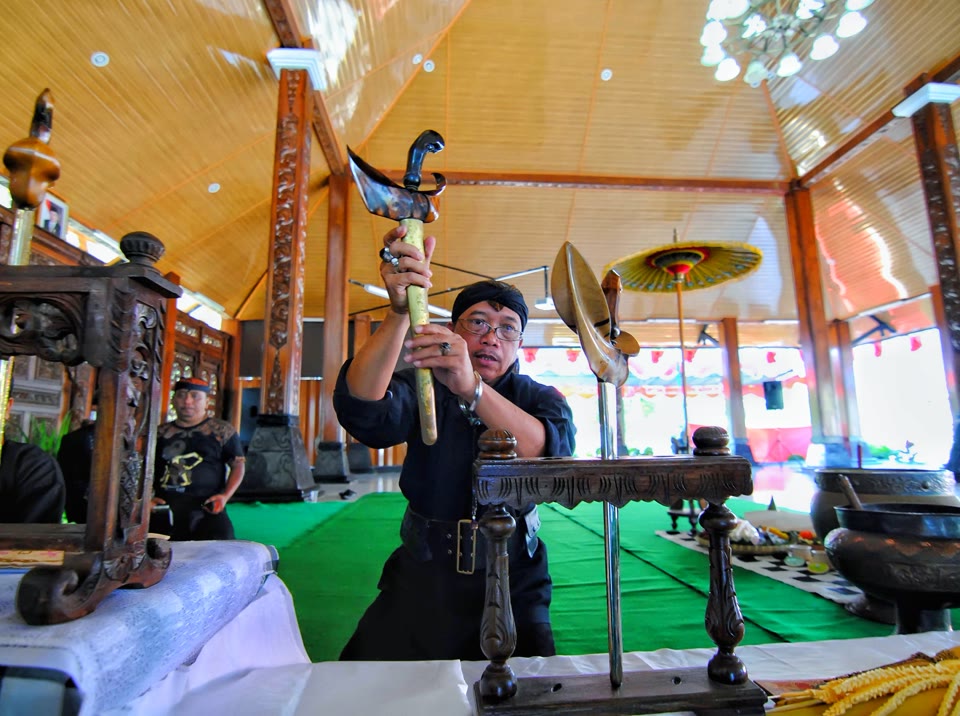
In the gleam of the blade, he suddenly remembered the old craftsman in the corner of the hall in Majapahit.
If you use it to kill the innocent, the heavens won't punish the blade first. The heavens will punish the king who commanded this blade to be drawn.
Jebat was guilty.
But was Jebat meant to die from the very beginning?
This question pressed close to his heart, colder than the blade's edge.
Hang Tuah's blade grew more and more precise.
Jebat's blade grew heavier and heavier.
In the end, Jebat was already covered in wounds. He still smiled.
"You see," he said, "you finally struck for yourself."
Hang Tuah shook his head.
"No."
Jebat looked at him.
"Then it is even more pitiful."
The final moment was not as clean and crisp as later generations recounted.
Hang Tuah had pulled his blade back half an inch.
Jebat saw it.
He also knew that if this battle dragged on any longer, more people outside would die, more treacherous thoughts would sprout in the palace, and Hang Tuah's family would not be safe.
And so Jebat took a step forward on his own. He didn't lose his footing, nor was he forced; he simply offered his body to that blade edge pulled back half an inch.
As the blade entered his abdomen, Hang Tuah's hand froze.
Jebat leaned close to his ear, his voice very light.
"This time, it counts as my win."
Because he had finally made the steadiest hand of Hang Tuah's life lose its steadiness.
Hang Jebat died at Hang Tuah's hands.
XVIII. After the Victory#
The royal palace finally quieted down. The Sultan regained his authority, and those who had dodged the gleam of the blades finally dared to exhale a long breath.
According to the style of old historians, with the rebel minister dead and order restored, it is here that the pen should be laid to rest. But while the palace doors can reopen, people's hearts may not necessarily return to their original places.
Hang Tuah stood in the blood, looking at Jebat's sword.
He didn't cry, nor did he immediately sever Jebat's head. He just knelt before the pool of blood for a long time.
So long that those outside the hall thought both men inside had died.
Finally, Hang Kasturi came in and said in a low voice:
"Brother, the King is waiting."
Only then did Hang Tuah move.
His movements were sluggish and heavy, showing not the slightest appearance of a victor; it was more like he was about to hand over the last remaining pieces of his heart as well.
He just suddenly remembered how, when they were young, Jebat was always the first to charge out. He thought back then that his job was to bring Jebat back.
Only later did he realize that the way he brought Jebat back for the last time was by killing him.
XIX. The Silence of Two Women#
Tun Teja heard that Hang Jebat was dead.
She didn't ask for details.
She didn't ask for details because she had known all along how Hang Tuah would choose. It wasn't that he was heartless; it was just that whenever a royal command arrived, he always pushed his own affections one step back. Step by step, until finally, he had retreated to a place with nowhere left to go.
The Princess of Mount Ledang heard it too.
There were no sudden downpours on the mountain, nor any divine manifestations. The princess only stood in a high place, gazing far off in the direction of Melaka.
In this story, she had waited for Hang Tuah to speak. What she waited for was not a word of love, but simply the word "no."
He had not.
And so she remained on the mountain.
Tun Teja was the person taken away by the royal command.
The Princess of Mount Ledang was the person who refused the royal command.
Hang Jebat was the person who fought against the royal command.
Hang Tuah was the person who executed the royal command.
The four of them walked four different paths, yet at the end, they all led to the same wound. And the story of Melaka began to ache from here as well.
XX. The Cracked City#
After the Seven-Day Battle, Melaka remained lively.
The ships came as usual, the spices gave off their pungent scents as usual, and there were still people whispering in the long corridors of the royal palace.
Hang Tuah was still there, too.
Hang Tuah was still there, but he was no longer as decisive as before. It wasn't that his hands had grown slow, but that every command reaching his ears had to first pass through the voice of a dead man.
"Will there ever be a single time in your life when you stand opposite the royal command?"
He never told anyone this sentence.
A loyal subject can be rewarded, can be sung in praises, can be written into stories.
But some questions cannot be covered up by rewards.
The people at the port saw things more practically.
They had no time to determine whether Jebat was loyal or treacherous.
They only asked three pressing matters: were the warehouses still secure, were the debt ledgers still honored, and would tomorrow's ships still sail.
XXI. The Portuguese Ships#
When the silhouettes of the new ships truly appeared on the sea, this question was already waiting for them in the city.
This time, it wasn't the pirate ships that could be trapped by the tide like when they were young.
These ships were taller, their cannons shot further. They hadn't come just to rob a single merchant ship. What they wanted was the port, the warehouses, the tax routes, and the throat of the kingdom.
Two voices quickly emerged in the city of Melaka.
One said, defend.
The other said, calculate.
Among those who advocated to "calculate" first, one man walked out from the counting house.
He was no longer young, not tall in stature, but stood very firmly. He wore a thin, white cotton long shirt with a dark cloth draped over the outside; at his waist there was no warrior's keris, only a ring of warehouse keys that clicked lightly together when he walked. He wore rings on his fingers, but the edges of his nails were stained with ink.
When the people on the docks saw him approaching, they always lowered their voices a few notches. He didn't wear a sword, and he didn't kill people; yet many people's goods, debts, shipping schedules, and guarantees had once been laid out on his table.
His name was Nina Chatu.
He was not Melakan royalty, nor a noble who entered the court wearing a sword. He belonged to the South Asian merchant world that had come to Melaka via the western monsoon routes: there lay the Coromandel Coast, Gujarat, Goa, Calicut, and many ports that made a living off the sea. After arriving in Melaka, he became one of the influential Hindu merchants in the city. Before and after the Portuguese attacked the city, he had mediated and passed messages for the imprisoned Portuguese; after the city fell, Albuquerque appointed him as Bendahara. 22,23
If we were to cover his face with just the word "traitor," this man would be written too easily.
The Melaka in his eyes was not the one sung by the poets.
It was the lock on the warehouse door, the wet cloth, the late ship, the people waiting to get stamps at the Syahbandar's desk. It was a certain noble in the palace who borrowed silver and refused to pay it back even after the monsoon had passed; it was also a foreign merchant who had just stepped off a ship and didn't know who to give gifts to first, realizing his mistake in expression before he even finished speaking.
A rich port didn't mean everyone was comfortable.
The Muslim merchants had their avenues, the Javanese had their fleets, the Gujaratis had their money. A man like Nina Chatu could survive long enough to gain influence because he knew how to bow his head, and how to calculate accounts; he knew how to speak softly in the royal palace, and how to record a debt in a ledger so that no one could back out of it.
He revered his own gods, but he was also accustomed to the masses on the docks. When a merchant settles in a place, the first thing they usually inquire about is not what faith the king holds, but whether their warehouse doors will be smashed, whether old debts will still be honored, and whether tomorrow's ships can unmoor as usual.
But there was one thing he had never let go of.
It was a small Hindu temple.
They called it a temple, but it wasn't large. There was no soaring gateway tower, nor an ornate roof ridge that distant ships could spot at a glance. It was just a place of incense wedged between shops and warehouses: a low building, a stone pedestal, a few oil lamps, and flowers hung by the door. Before the market opened in the morning, people came to press their palms together; before heading out to sea, people came to pray for a safe journey; and after ledgers were settled, some brought a bit of sweet food to fulfill a vow.
In his youth, Nina Chatu believed that Melaka's preciousness lay exactly here. The port was full of diverse people and customs, yet they could all find a small place of their own within the city, avoiding being casually crushed by someone else.
Muslims could heed the call to enter the mosque, Chinese could tend their ancestral graves and wells by Bukit Cina, Keling merchants could light lamps before their own gods, and Javanese sailors could sing their own songs by their ships. If a port could allow these people to live by their own rules, the ships would be willing to return, and the ledgers would be willing to stay.
But later, a noble in the city set his sights on the land in that area.
They said it was to widen the road.
They said it was to clear out the warehouses.
They said there were too many people around the temple, and the incense smoke disturbed the newly built official residence.
Each reason sounded grand on its own, but together they amounted to just two words: give way.
Nina Chatu went to plead with the Syahbandar, pleaded with the Bendahara's people, and had messages sent into the royal palace. He wasn't asking for special privileges, just a clear piece of paper: this temple had been here for years, supported by merchants, recognized by passersby. If it truly had to move, they should be given a respectable piece of land and enough time to move the statues and ledgers over properly.
The reply that came back was very light.
"The King's affairs are busy."
The small temple was eventually relocated. No soldiers came to smash it, and no one shed blood in the streets, so many people said this didn't count as an injustice.
But Nina Chatu remembered that day: the old men blew out the oil lamps, the young men lifted the stone pedestal, the flower garlands were taken down from the door, and the incense ash was packed into small jars. A child asked if the gods had to move houses too. No one answered.
From that day on, the Melaka in his eyes contained more than just prosperity. The path that allowed everyone a place to exist was silently narrowing.
Later 16th-century materials would also leave clues of Keling/Tamil merchants petitioning the Portuguese King with a collective voice, showing that this South Asian merchant community was not without its own interests, memories, and demands. The relocation of the temple in this text is a fictionalized synthesis made using the circumstances of such communities, not a case recorded verbatim in extant documents. 22,23,25
He had heard the stories of the Portuguese.
These stories were not in books, but in ship cabins, counting houses, and beside spice sacks, arriving stage by stage with the accents of the sailors.
People arriving from Cochin said the Portuguese had gained a foothold there early on, relying on fortresses, ship cannons, and local allies to turn a port into the root of their eastward reach. Others said that what they wanted on the west coast of India was never just a single transaction, but a string of strongholds where they could dock ships, station troops, and collect taxes. 26,27,28
Later, the news became increasingly heavy: Calicut had burned, and Goa had bled.
They said Albuquerque was determined to control the key routes of the Indian Ocean, not merely to trade, but to ensure that trade passed through his cannons, his checkpoints, and his documents. In 1510, he first attacked Calicut, then seized Goa; Goa was lost and then recaptured, and after taking it the second time, the Muslim defenders were slaughtered, and many civilians died in the chaos. 26,27,28
By the time these words reached Melaka, they were no longer a straight line.
When Muslim merchants spoke of it, the Portuguese were the ones severing the old trade routes, maritime robbers arriving with crosses and cannons.
But when some Indian merchants spoke of it, it wasn't entirely the same.
They said the Portuguese were cruel, yes, but they didn't kill everyone in sight. They differentiated people. Whoever blocked their path was an enemy; whoever could open markets, supply grain, recognize routes, and keep accounts for them might be allowed to stay, or even be elevated to a new position. In his subsequent arrangements in Goa, Albuquerque had also tried letting different communities live under their own headmen and old laws, while encouraging the Portuguese to settle down and marry, thereby turning a fortress into a city. 27,28
Nina Chatu dared not believe these rumors entirely, nor did he dare miss a single sentence.
When he turned the pages of his ledgers at night, he often paused at the same spot.
If the Sultan held Melaka, he would still be an outsider merchant in the royal court, having to bow his head, give gifts, and wait for the nobles to be in a good mood before a paper of permission would come back.
If the Portuguese won, he would be facing not the old court, but a group of people who had just walked over carrying the smell of gunpowder from Goa and Calicut. They would speak of contracts, and they would also turn hostile; they would demand taxes, and they would bring crosses into the city; they might give a Hindu merchant an official post, and they might flip that same table over when the next wind turned. 27,28
He was certainly afraid. Afraid of a reckoning if the old master won, and afraid of hostility if the new master took the city; he was even more afraid that both sides would treat Melaka like a cash box, smashing it to pieces during the struggle, and afterward telling the people of the city to clean up the wood splinters themselves.
Nina Chatu did not stake his life and fortune on the mercy of conquerors.
Nor did he stake it on the justice of the Sultan's court.
He calculated precisely only one thing: no matter who sat in the high seat, they would ultimately still need someone who understood accounts, knew the routes, and knew how to make the market open its doors again. And he happened to have exactly those skills.
So when the Portuguese sought out Nina Chatu, he didn't agree immediately.
He asked first:
"If the city changes hands, does the port still count?"
The translator relayed the words to Albuquerque. That Portuguese general smiled faintly and said:
"The port certainly counts. That is what we came for."
This sounded like a guarantee, but Nina Chatu heard the price behind it: they came for the port, not for the people in the city.
If the port was to open, people could be kept; if the port didn't open, people could also be swept away.
Nina Chatu asked again:
"What about the debts? The warehouses? The merchants and families who stay behind?"
Albuquerque didn't answer immediately.
This pause, Nina Chatu remembered exceptionally clearly. Matters in the counting house that were delayed in agreement were often left for a new price to be quoted later.
He then knew he couldn't just open the door for the Portuguese.
He had to negotiate a few memorable words for those staying behind, before the door was fully opened.
Thus, Nina Chatu understood that this war couldn't be summed up with just the words "loyalty and righteousness." The Sultan wanted his subjects to die with the city; the Portuguese wanted the port to open its doors. A man caught in the middle must first protect his family, his cargo, and save the city from a little more innocent blood.
This doesn't necessarily mean he was worse than others. He was simply earlier than many to admit: dynasties fall, flags change, but the ledgers still need to be kept, and the people on the docks still need to eat.
Yet such a choice was by no means clean.
He knew that if he bet wrong, the old king would curse him as disloyal, the new master would despise him as useless, and the people of the city might not necessarily be grateful to him either.
He knew even better that even if he bet right, the Portuguese wouldn't suddenly become benevolent rulers just because of a few words from him.
All he could do was, before the blade fell, shift its edge away just a little.
He had also heard the story of Hang Tuah and Jebat.
The whole city had heard it.
A loyal minister sentenced to death, a brother rebelling into the palace, a hidden dead man summoned back to kill his own brother. Hearing this, Nina Chatu didn't sigh over loyalty and righteousness like the poets.
He said:
"Such a palace will sooner or later drag the port down with it."
The words were cold, but one couldn't say they were completely without reason.
When Hang Tuah learned of this, he didn't call him a "traitor."
He was only silent.
Because he suddenly saw that Nina Chatu was actually asking the same thing, only his way of asking was colder: if the kingdom cannot protect the people in the city, should the people still sink along with the kingdom?
This question was colder than the enemy's cannons.
XXII. The Last Defense of the City#
Hang Tuah summoned the remaining brothers.
Hang Kasturi, Hang Lekir, and Hang Lekiu were all old.
Their names were still the names of their youth, but their shoulders were already heavy with the years.
Chen Guan came as well.
He was no longer the thin youth from the foot of Bukit Cina all those years ago. There was white at his temples, and his back bent a little, but he still held the bamboo tally commonly used in the counting houses. He didn't bring soldiers; he brought a few Chinese men who knew the roads, several women carrying baskets on shoulder poles, two broken carts, and water buckets, rice sacks, and herbs brought down from the mountain.
Seeing him, Hang Lekiu managed a smile.
"You call this bringing troops?"
Chen Guan said:
"Soldiers guard the gates; people guard lives. Each has its use."
Hearing this sentence, Hang Tuah remembered the three water characters on the table many years ago.
"If Jebat were still here," Hang Lekiu said, "he would curse us first."
No one laughed.
Hang Tuah looked at the city gates.
"He would curse us for growing old and still following orders."
Hang Kasturi said:
"He would also curse us if we didn't defend it."
Everyone knew in their hearts that Jebat would curse them either way. He never wanted people to shirk their responsibilities; he only hated those who pushed everything onto the royal command, turned around, and thought their own hands were clean.
This time, Hang Tuah did not say again, "I only guard the royal command."
He looked at the people fleeing the city: someone carrying a child, someone carrying an old mother on their back, someone dragging a sack of rice that hadn't yet been sealed. There were also people coming down from Bukit Cina, their clothes stained with mud, clutching only a single key in their hands.
He said:
"This time, we guard the people."
They led the men to defend the street intersections, the warehouses, and the ferry crossings. They were not only protecting the king, but also those commoners who couldn't board a ship in time, protecting those who knew nothing of court struggles yet were about to be overtaken by cannon fire.
Chen Guan led people to guard the back alleys.
He didn't know how to use a keris, but he knew how to divide the routes. He had the elderly take the low paths first, had the children move through the shadows of the walls, and told those carrying water to stop at intervals, lest the crowd panic and trample each other. When someone asked him where they should flee, he only said:
"First, get a little further away from the sound of the cannons. The mountain recognizes people, and the alleys recognize people too."
Today, if one goes to Melaka seeking traces of that war, the easiest thing to see is not the wooden palisades of the Sultanate, nor the bridgehead Hang Tuah supposedly defended in the legends.
Wood, bamboo, sails, ropes, and temporary gun emplacements are hard to preserve in their original state after five hundred years.
What remains are the shadows of the stone fortresses built by the Portuguese after the city fell, and later altered by the Dutch and British. A’Famosa / Porta de Santiago still stands, and display cannons are often seen before the gate. They allow people to see how Melaka transformed from a port into a city rearranged by cannon muzzles and fortresses; but the cannons in the pictures should not be directly read as original artifacts from the 1511 battlefield. 31,38
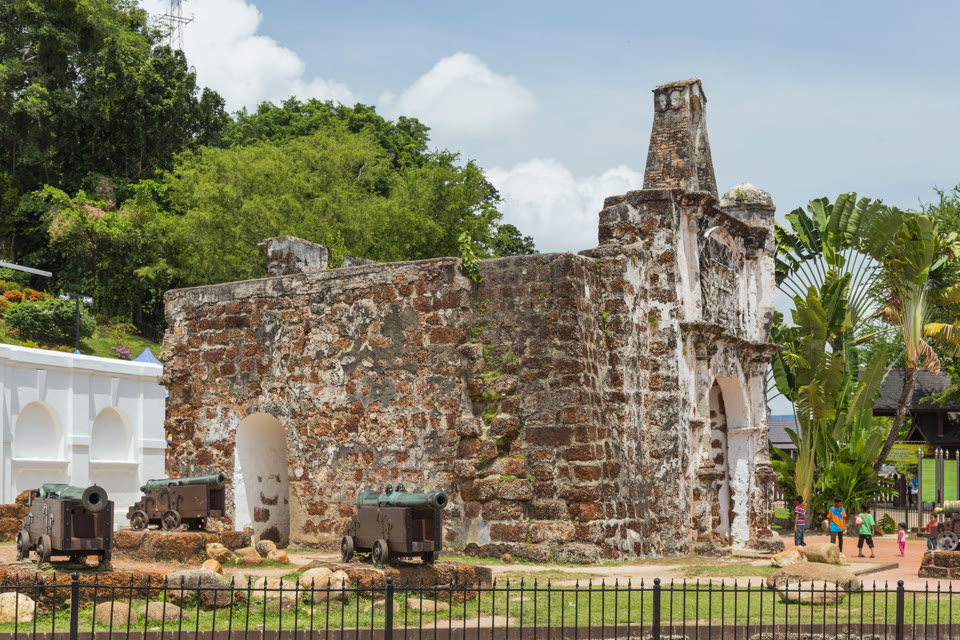
The Portuguese ships spoke with cannons first.
The sound of cannons rolled from the river mouth into the city; the beams and pillars of the wooden houses shook first, and then people's hearts shook with them. It wasn't that Melaka had no cannons, nor that they had no soldiers. It was just that the Portuguese fought differently. They didn't just frighten people from the sea; they wanted to seize the bridge.
The Melaka River ran straight through the city; once the bridge was lost, the entire city would be like a man grabbed by the throat.
During the first attack on the bridge, the Portuguese landed after midnight, on one side at Upeh, pressing toward the royal city and the mosque. The Melakans held them off with palisades, arrows, cannons, and walls of men. War elephants were also driven out, the men on their backs shouting, trying to trample the foreign soldiers back into the river.
Standing by the bridge, Hang Tuah saw the iron helmets and breastplates of the Portuguese flashing in the firelight. They were afraid of the heat, the humidity, the poisoned arrows, but they were not afraid to huddle together and push forward. When the front row fell, the back row filled in. When the cannons stopped, the drums took over.
That iron armor, in the sweltering heat of Melaka, was like a scorching hard shell.
But it could block many blade edges. When the cloth garments, rattan shields, wooden palisades, and courage of the Melakans met the iron helmets, breastplates, long pikes, and firearms, the sounds all changed. A blade striking cloth is a muffled thud; striking iron, it is a clang that makes one's heart sink.
"Defend the bridge," Hang Tuah said.
Hang Kasturi led men to guard the west street intersection, Hang Lekir went to the rooftops to find the enemy's musketeers, and Hang Lekiu led the young men to drag rice sacks and wooden crates to block the roads. Hang Tuah himself guarded the bridgehead, rarely drawing his sword, mostly using a long spear to push men off the bridge planks.
On that day, Melaka did not immediately lose the battle.
The Portuguese captured the bridge, but retreated to their ships because of a lack of food and water, and the sun being too toxic. People in the city began to cheer, as if victory had already arrived.
Hang Tuah did not cheer.
He saw that the Portuguese had burned several houses before retreating, and he also saw that their eyes remained fixed on the bridge.
He knew they would return.
The second time, they prepared more meticulously.
A large ship was loaded with cannons and sandbags, pushed toward the bridge on the rising tide. The ship also carried very long pikes, used to fend off approaching fire rafts. The Melakans launched fire rafts, but before the fire could get close, they were broken apart by the long pikes and small cannons. The area around the bridge was a cloud of smoke, and the smoke was full of shouts.
The smell of gunpowder overpowered the smell of spices.
That was what the Melakans were most unaccustomed to. Usually, the docks smelled of pepper, dried fish, wet hemp rope, and wooden crates; this day, their noses were filled entirely with saltpeter, burning wood, burning cloth, and the fishy stench of river mud churned up by cannonballs.
In the second assault, Albuquerque divided his forces more finely: one squad pressed the bridge, one attacked the rooftop cannon positions, another advanced toward the mosque, and some were dedicated to guarding the retreat route.
Hang Tuah led men to charge out from the side alleys, slicing through the Portuguese squads several times. But the enemy's cannons quickly turned around, shattering the wooden walls at the street intersection, sending wood splinters flying into people's faces.
He saw a young soldier about to rush out to retrieve a flag.
Hang Tuah grabbed him.
"The flag can be lost; men cannot die for nothing."
The young man's eyes were red.
"Laksamana, will we lose?"
Hang Tuah looked at the bridge.
He wanted to say "no." As the words reached his lips, he remembered he was no longer that youth who dared to promise everything, and finally only said:
"Let the people behind us leave first."
By the third day of defense, the Sultan sent someone to find him.
That person didn't bring an order first, but a message:
"His Highness wants you to go to the river mouth."
The river mouth no longer looked like the royal palace.
The palanquins of the royal family were crowded to one side, horses were being led, and even their neighing seemed suppressed. The Bendahara's men clutched document boxes, the corners of the boxes still stained with ash. Shipwrights, accountants, harbor officials' retinues, and several scribes who could write Arabic and Jawi script were all called near. There were also many Muslim merchants from Gujarat, Coromandel, Pasai, and various archipelago ports; the clerks hastily stuffed scales, ledgers, seals, Qurans, and small bags of silver coins into wooden chests, their usual shrewdness now transformed into tightly pursed lips.
Not everyone would leave. Some were destined to stay, because their homes, ships, fields outside the city, and ancestral graves were all here.
But that night, a group of people did indeed decide to follow the royal line and retreat south. They had heard the Portuguese cannons, and they had heard of the new taxes; they knew that if a port changed its rules, what would be bent first wasn't often the court, but the warehouses, the debt ledgers, and the places of prayer.
The Sultan, Mahmud Shah, stood on a temporarily raised wooden plank.
There was dust on the hem of his robe, and his golden waist belt was slightly askew. The man who had absolute authority in the palace during the day now only had a river, ships, firelight, and a city he was losing at his back.
He did not immediately say 'leave.'
He first looked at the crowd.
"Listen to me."
At first his voice was not loud, but the riverside gradually quieted down.
"Melaka did not come into being just today. Our ancestor Parameswara came out of Palembang, passed through Temasek, and finally stopped by the Bertam River. At that time, this was not yet a place where ships from all over the world scrambled to come. There was mud here, there were trees, there was sea breeze, and there were people willing to make a living at the mouth of the river."
He paused for a moment, as if trying to pick back up a name that had been scattered by cannon fire.
"Later, the Emperor of the Great Ming recognized us, bestowed a seal, bestowed an edict, bestowed robes. Our former kings took their wives, sons, and attending ministers far away to the Ming imperial city to pay tribute. That was not an empty name. That was the world knowing: Melaka is not a small shack by the sea, Melaka is a state with a king, with laws, with a port, and with trust and righteousness."
Some people bowed their heads.
Hang Tuah also bowed his head.
In his youth, he only knew the weight of a royal command; only on this night did he realize that behind the royal command lay ledgers, docks, letters, marriages, granaries, religion, and the destination of an entire group of people.
Chen Guan stood at the back of the crowd, holding a water bucket, watching him through the firelight.
Hang Tuah suddenly thought of that night, the lamp at the foot of Bukit Cina, the water characters on the table that were about to dry.
The People.
The State.
The Sovereign.
It turns out that some words, when heard, are just water marks; it takes many years before they seep into the heart.
The Sultan continued:
"We once made this strait bow its head. Not because our city walls were the highest, but because ships coming from the windward side and ships coming from the leeward side all knew that in Melaka, you could wait for the monsoon, clear customs, exchange goods, and hear over eighty different languages, yet there was still one law suppressing the chaos."
The sound of cannons came from the city.
No one looked back.
"Today the city may fall," the Sultan said, "but the royal line must not be broken. Take the documents, take the seals, take those who can build ships, take those who can keep accounts, take those who know the waterways. Take the children, take the old mothers. Those willing to follow me, go south first. If Heaven wants us to gather again in Bintan, in Johor, or at the mouth of another river, we will raise our flag anew there."
He raised his hand and pointed at the burning city.
"Today the Portuguese may take the city gates, but they cannot take this sea. They may take the warehouses, but they cannot take away our memory of where we came from. Go back and tell those scattered along both shores of the strait: the royal line of Melaka is still here. As long as the royal line is still here, one day, we will return."
There was courage in these words, but also hidden fear. Hang Tuah could hear it.
A king in retreat fears most that others only see the retreat; he wants everyone to believe that what he takes with him is not a few boxes of documents, but an entire unbroken royal lineage.
The Sultan took the gold seal from someone beside him.
This time, he didn't send someone else to pass it on.
He personally had the gold seal brought before Hang Tuah.
"Laksamana," the Sultan said, "you come with me."
Hang Tuah looked at that gold seal.
In all his life, he had almost never refused it.
He had crossed the sea for it, brought a woman into the palace for it, walked out of the tomb-like darkness for it, and drawn his sword against his closest kin for it.
This time, however, he did not kneel.
"Please, Your Highness, go first," he said.
The people by the river all heard it.
The Sultan's face changed.
"This is a royal command."
"The royal line should go," Hang Tuah said, "but someone must stay for the people in the city."
"If you stay," the Sultan lowered his voice, "later generations will think you were disloyal."
Hang Tuah looked toward the cannon smoke beyond the city gates.
"Then let Your Highness think so."
Saying the words brought him not a shred of satisfaction, only the feeling that it was too late. Half a lifetime late, he finally shifted the word "loyalty" from a monarch to the lives of a city full of people.
As he turned, he saw a few young soldiers still standing by the dock. They didn't know whether to follow the king or return to the city. They held long spears in their hands, the tips trembling slightly.
One of them asked:
"Laksamana, if we leave, will Melaka be gone?"
Hang Tuah didn't answer immediately.
He looked at the surface of the river, at the ships illuminated by firelight, at the people leaving with ledgers and children, and at the streets and alleys in the city still waiting for someone to block the blades.
Then he said in Malay:
"Takkan Melayu hilang di dunia."
Malays will not vanish from the world.
The voice wasn't loud amidst the cannon fire, but the people by the dock all heard it.
Hang Tuah continued:
"Those who leave, take the name with you; those who stay, protect the living. The city may be broken, but the origin in people's hearts cannot be broken. As long as someone still remembers, Melaka will be more than just a pile of ash."
When the Portuguese cannons sounded, Hang Tuah remembered the Seven-Day Battle.
He had thought then that his greatest enemy was his brother's sword.
Only later did he realize that what internal strife shatters, foreign enemies will quickly reach out to take.
XXIII. After the City Fell#
After the city fell, the royal line retreated south. Along with the royal family and ministers was a group of Muslim merchants.
They didn't all necessarily love the Sultan, nor did they necessarily believe the old court was all that just. Some had even had enough of the royal palace's demands, the port officials' looks, the nobles' debts, and the unreasonable commands.
But they understood one thing even more clearly: if the Portuguese brought their cannons, tax ledgers, and religious slighting into the city all at once, Melaka would no longer be the Melaka they knew.
And so they rolled up their ledgers, packed their scales into boxes, woke their children, and took whatever silver and spices they could carry. Without this group of people, the port was like a ship with several of its main beams pulled out; it would still float, but it would no longer be as steady as before.
When the city gates were opened, Melaka did not immediately fall into silence. What poured in first were fire and shouts, the thunder of military boots trampling over wooden planks and warehouse doors being smashed open, and the panting of mothers pressing their children tightly to their chests. True silence came much later.
Hang Tuah led the remaining people in a retreat to the sea.
He no longer thought of royal commands.
He thought of the row of houses behind the street that hadn't had time to flee, of the boatmen beneath the docks, of those who might not have even seen what the Sultan looked like, yet had to pay for the kingdom's failure.
When the Portuguese surrounded him, he didn't have many men left.
Hang Kasturi had taken a cut to the shoulder, Hang Lekir's arm hung limp, and Hang Lekiu's face was covered in ash. But they did not kneel.
Albuquerque came to the front.
Nina Chatu was also beside him.
There was no smile of a victor on his face.
Before the city fell, the Portuguese had already promised him a position.
Not a throne.
Nor an empty, pleasant-sounding title.
They wanted him to manage the remaining local affairs on behalf of the new masters, to speak for the merchants, and to build a bridge between the non-Muslim communities and the Portuguese. Historical materials later indeed recorded: after the city fell, Nina Chatu was appointed Bendahara by Albuquerque. 22,23
Therefore, his standing beside the Portuguese at this moment was no accident. He had chosen this ending himself, yet seeing it actually descend still left him momentarily speechless.
Looking at war through a ledger, the numbers can shield people from many things.
How much a ship of rice costs, how much a warehouse holds, how much tax is lost if a street doesn't open for the market—all these can be calculated.
But arriving at the seaside, seeing wounded soldiers supporting wounded soldiers, seeing women clutching children hiding behind fallen wooden beams, seeing Hang Tuah plant his sword in the sand, he realized that some ledgers are not impossible to calculate, but even when calculated clearly, they cannot bring a person peace of mind.
Seeing Hang Tuah, he merely gave a slight nod. A man who had calculated accounts his whole life had finally encountered a ledger that could never, no matter what, be balanced.
Portuguese texts say that Melaka had a high official called Lassamane / Laksamana, who was the Admiral of the Sea. 5,24
Resting upon that historical shadow, this story arranges one final conversation for Hang Tuah.
Albuquerque looked at him and said:
"If you are willing to stay, you may still command the soldiers on the sea."
After the translator finished, the surroundings fell quiet.
This was no ordinary offer of surrender.
The Portuguese wanted the port, and they wanted people who understood the port. They already knew that a man who could read the tides, who could hold a ferry crossing, who could keep veteran soldiers from scattering even in defeat, was more useful than ten men who only knew how to shout their loyalty.
Hang Tuah planted his sword into the sand.
He did not hand the sword over.
Nor did he raise it again.
"I will no longer be anyone's blade," he said.
The translator hesitated for a moment, but still repeated it as spoken.
Albuquerque narrowed his eyes.
"What do you want?"
Hang Tuah said:
"Do not harm the commoners in the city. Do not kill those who hold no swords. Do not let the soldiers enter civilian homes to seize women and children. If my men lay down their weapons, let them take the wounded and leave."
Hearing this, Nina Chatu finally spoke up.
He told Albuquerque that doing so would also benefit the Portuguese. If the port was to reopen for the market, those who remained could not be left only with memories of a massacre. Merchants need order, commoners need a way to survive, and new masters need taxes—and taxes cannot be collected from dead men.
These words were so cold they bordered on heartless.
But precisely because of that, they reached Albuquerque's ears.
Albuquerque looked at Hang Tuah for a long time.
Albuquerque, of course, had not forgotten he was a conqueror because of a few words. Conquerors never forget the swords in their hands so easily.
But he saw something else: a general of a defeated kingdom, refusing to flee with the old king, and refusing to act as a blade for the new king, yet using his final moments to beg a path of survival for the weakest people in the city.
This was neither a surrender, nor could it be counted as a victory. It was merely a man walking to the very end, finally taking the word "loyalty" down from before the throne, and placing it beside the living.
Albuquerque finally said:
"Let them go."
And so Hang Tuah took his remaining brothers and the wounded soldiers, slowly leaving the seaside.
He did not look back at the city tower.
Some say he later went to Mecca. Some say he went to Rum. And some say he went to a very, very distant place, where no one ever called him Laksamana again.
In this story, he passes by the sea for the last time.
The tide is receding.
Just like when he was a boy.
But this time, he sets no ropes, and he lures no enemies.
He only stands amidst the sound of the tide, watching a city hand its name over to those who come after.
And in this story, the Melaka in Hang Tuah's heart had already cracked the day Hang Jebat fell. He remained a loyal subject, but he finally understood that the word "loyalty" cannot answer all the rights and wrongs of the world.
Loyalty is like a blade, and also like a scabbard.
If a man only knows how to grip the blade, without asking whether it ought to be drawn, the blade's edge will eventually clear a path for a wrongful command.
XXIV. An Unfinished Question#
Later generations said that Hang Tuah would not die.
These sayings are like mist on the sea—one can believe them, or not. As for where he finally went, perhaps that is not the most important matter at all.
What truly did not die was the question he left behind.
If the royal command is wrong, what should a loyal subject do?
Hang Jebat asked it with his sword.
The Princess of Mount Ledang asked it with her conditions.
Tun Teja did not ask, because she had already spent her life knowing the answer.
Many years later, Hang Tuah finally opened his mouth to ask it as well. But by then, the brother who most wanted to hear the answer was no longer there.
The next story can begin from the aftershocks of Majapahit, Tun Teja's silence after entering the palace, or the old ministers continuing their tale after Melaka's retreat south. What is truly hard to write is not how Hang Tuah won, but what he lost after every victory.
Story Disclaimer#
This piece is a novelistic adaptation drawing from the Hikayat Hang Tuah, the Malay Annals, Malay folklore, and certain historical studies. The historical figures, legendary characters, place names, dynasties, and war backgrounds appearing in the text are partly derived from literature and partly from later legends; specific dialogues, psychological activities, emotional entanglements, childhood details, court scenes, and certain plot arrangements are literary fictions created by the author for the needs of the narrative.
Should the contents of this text bear similarities to strict historical facts, other versions of local legends, modern individuals, or real-life events, apart from the historical references already explicitly stated, the rest are fictional; any resemblance is purely coincidental. This text is for literary and entertainment reading only, does not serve as a definitive historical conclusion, and does not allude to any real individuals.
Sources 38 Every important claim here can be checked. Open it and see.
Do not trust this site. Check it — every source below is clickable.
-
Search for this source ⌕ no direct link — this button searches for the work 2026-08-02 Report this source
-
Search for this source ⌕ no direct link — this button searches for the work 2026-08-02 Report this source
-
Search for this source ⌕ no direct link — this button searches for the work 2026-08-02 Report this source
This site is written with AI assistance. Please check us.
AI can invent citations that look completely convincing — a real author's name, a plausible title, a sensible year, for a work that does not exist. This is not a theoretical risk; it is a known failure mode. That is why every source on this site is clickable. If a reference cannot be found anywhere, it may well not exist — and we want to know.
How to check us →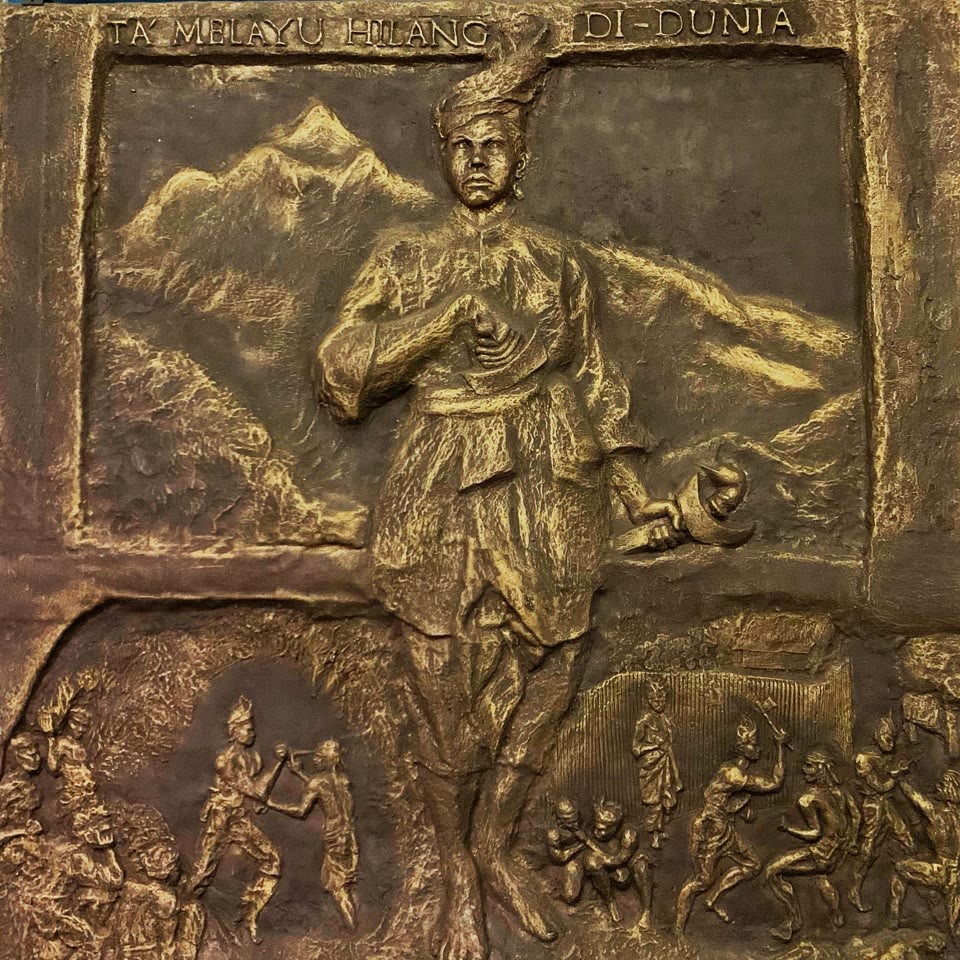
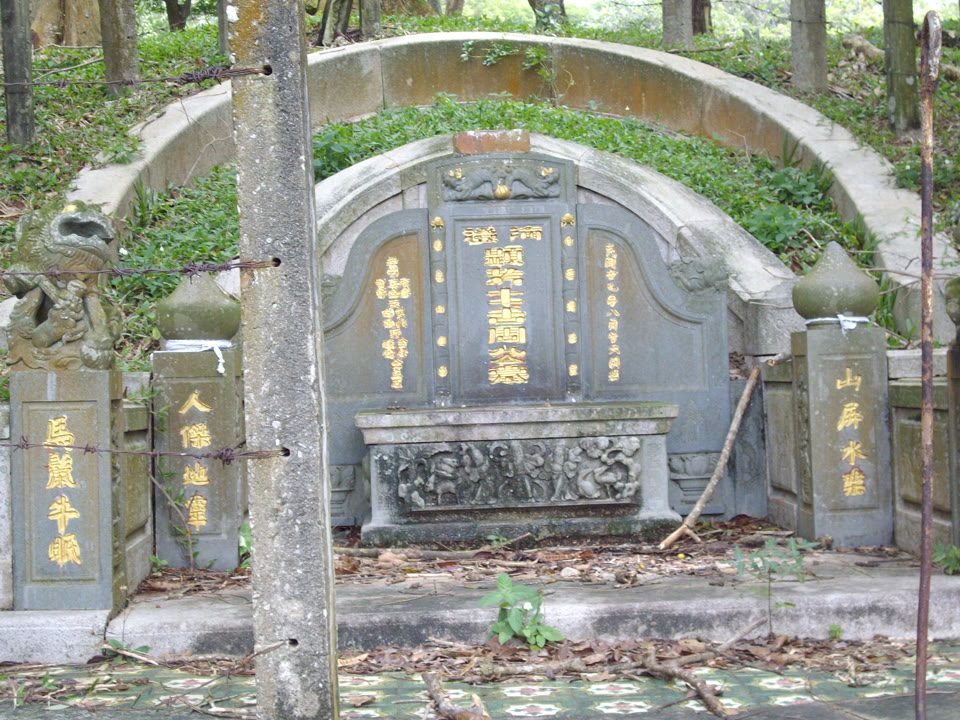
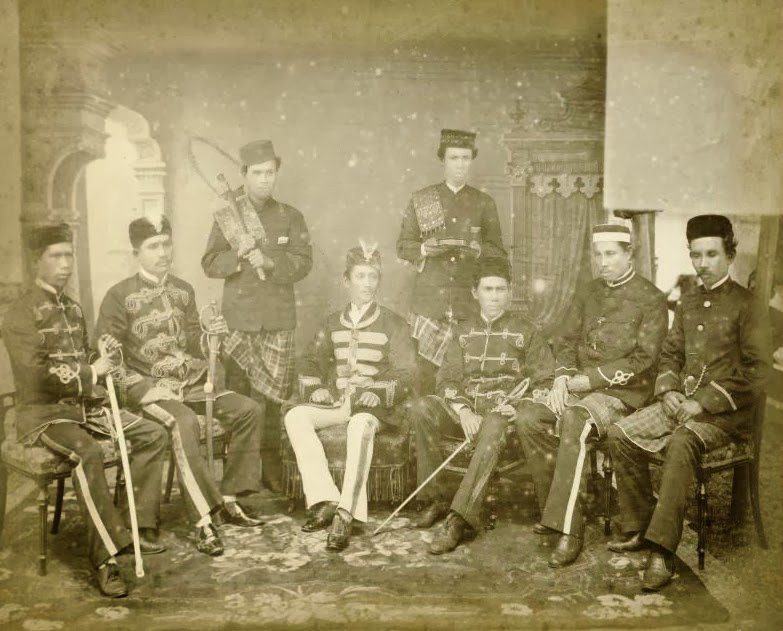
Reader Comments
Be the first to share your thoughts.