Why Did the Gates Open? The Fall of Singapura in the Malay Annals
A ruler shamed his officer's daughter; the gates were later opened, the fugitives pressed northward, and only then did the story of Melaka truly begin
The gates were not broken open with a single blow.
A Word Spoken in the Palace#
Chapter Ten of the Malay Annals records that after Raja Secander Shah inherited the throne of Singapura, he took as his wife the daughter of Mangkubumi Tun Parpatih Tulos, and there was also a Bendahara by the name of Sang Ranjuna Tapa. 1,3
Sang Ranjuna Tapa had a daughter of exceptional beauty, whom the ruler held in special favour. The other women of the inner chambers conspired against her, alleging that she had been unchaste. Raja Secander Shah, upon hearing this, flew into a rage and ordered that she be publicly executed at Ujong Pasar. 1,2
What weighs heaviest here is not simply death.
It is the humiliation.
The National Library Board's reading connects this episode to an earlier compact in the Malay Annals between ruler and subject: the ruler must not shame his subjects; the subjects, in turn, owe loyalty to the royal line. By publicly shaming the daughter of one of his officers, Iskandar Shah had already broken that ancient covenant first. 2,1
Sang Ranjuna Tapa said to the ruler: if his daughter had truly done wrong, let her be killed — but why must she be shamed in this manner? He then wrote a letter to the Batara Majapahit of Java. 1,2
The message was simple: if you wish to take Singapura, come now — the hearts of those within the city have already scattered. 1,2
The Ships from the South#
A pause is needed here.
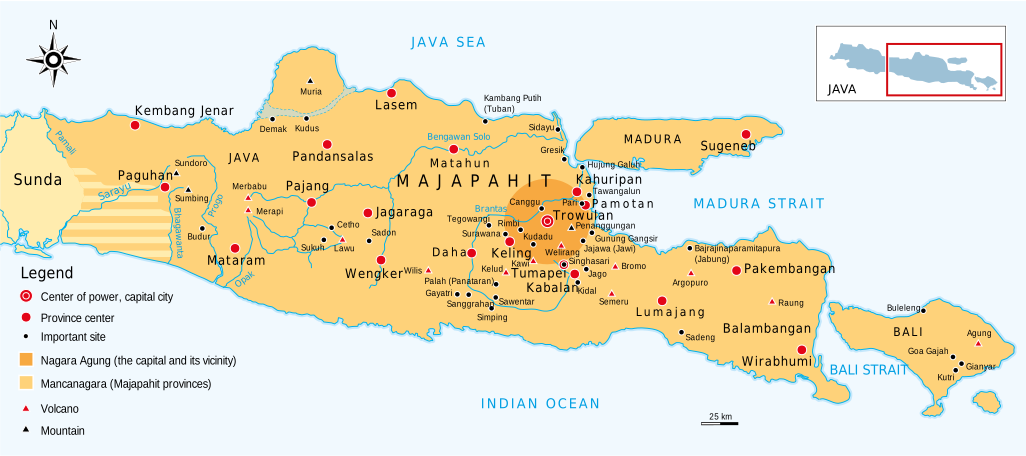
Today it is easy to read a map as a diagram of national borders: Singapore here, Malaysia there, Indonesia to the south. But in the late fourteenth century none of those names existed. The world of that era was woven from straits, ports, royal lineages, and tributory relationships layered upon one another.
Majapahit, in Java, extended its power across the sea. The Nagarakertagama of 1365 CE had already listed Palembang among Majapahit's domains; modern scholarship broadly reads the late fourteenth-century crisis at Palembang against the backdrop of Majapahit's expansion and the dissolution of whatever remained of Srivijaya's authority. 4,5
Pressure came from the north as well. The Portuguese tradition holds that Parameswara, after killing the local ruler in Singapura, was eventually expelled by Siamese retaliation; the Malay Annals, by contrast, identifies Majapahit as the force that destroyed Singapura. The two traditions reach different conclusions, but together they make one thing plain: the southern tip of the peninsula was not an island unto itself — it was caught between Siamese power from the north and Javanese power from the south. 3,6
The letter in the Malay Annals, then, was more than one family's revenge.
It joined a wound from within the city to the forces massing beyond its walls.
The Granary That Would Not Open#
The Malay Annals continues: Majapahit equipped three hundred large vessels, and countless smaller ones, and brought a great body of Javanese soldiers to Singapura. This figure carries the colour of epic; this site does not treat it as a verifiable number, only as the text's way of conveying the scale of war. 1,2
As the fighting dragged on, Raja Secander Shah ordered the Bendahara to distribute rice to the defenders.
Sang Ranjuna Tapa replied: there was no more rice.
The Malay Annals at once adds its own gloss: he said the rice was gone because, in his heart, he had already resolved to betray. 1,2
This is the most cinematic moment in the whole chapter.
The reader cannot see the layout of the entire city, nor hear the drums beyond the walls. But the reader can see one single act: the king's command to open the granary, and the keeper of the granary who would not open it.
Without grain, hearts scattered further.
At dawn the following day, Sang Ranjuna Tapa opened the city gates. The Javanese soldiers entered, Singapura fell; Raja Secander Shah fled, and made his way to Muar. 1,2
Whom Does This Story Condemn?#
The Malay Annals does not cast Sang Ranjuna Tapa as a hero.
At the close of the story, he and his wife are said to have turned to stone, their house-posts collapsed, and the land no longer fit for rice. This is legendary punishment, not verifiable geology. 1,2
But it is even more worth noting that the Malay Annals does not spare Raja Secander Shah either.
The text places the cause of the city's fall squarely on him: he listened to slander, he shamed his officer, he ruptured the mutual bond between ruler and subject. Then the subject betrayed him, the enemy entered the city, and the king himself fled. 1,2
This is where one must tread most carefully when reading his character through this episode.
In the version the Malay Annals offers, he is not simply a founder-hero without flaw. He possesses royal authority and he possesses a swift, ungoverned fury; he survives and he rebuilds; he has the wisdom to press northward in search of a new place to stand — yet he also had, at one moment, allowed an unrestrained royal command to drive his old capital toward ruin. 1,3
In other words, two things exist within him at the same time.
One is the fugitive's ability: when the city fell, he did not die within its walls, but led his people away and kept searching for the next place where they might take root. 1,3
The other is the ruler's danger: when power is not checked by custom and obligation, a single word can shame an entire household — and open a city's gates. 2,1
Two Sets of Accounts#
Yet we cannot take the Malay Annals as the only answer.
The Portuguese sources offer a different story: Parameswara was a prince who had fled from Palembang, who upon arriving in Singapura killed the local ruler and seized power, ruled for a time, was then expelled, and finally founded Melaka. 6,3
Ming dynasty records provide a third perspective: the founder of Melaka appears in the Ming court records under the name Bai-li-mi-su-la; in 1411 CE he travelled in person to Nanjing, accompanied by his queen, his son, and his retinue; in 1414 CE the Ming court recorded the arrival of his son, who came to report his father's death and request the succession of the royal title. 7,3
Taken together, the three bodies of material do not align on names, identities, or causation.
This article therefore does not adjudicate: whether Raja Secander Shah was in fact Parameswara, whether Sang Ranjuna Tapa truly opened the gates that night in the manner the text describes — the public record cannot yet yield a single agreed answer. 3,7
But what the Malay Annals intended to say is visible to us.
It meant for future kings to understand one thing: a city is not held by its walls alone. A city is also held by the ruler holding himself in check.
Why Singapura Belongs in the Melaka Story#
One might fairly say that this episode does not strictly belong to the history of present-day Malaysia.
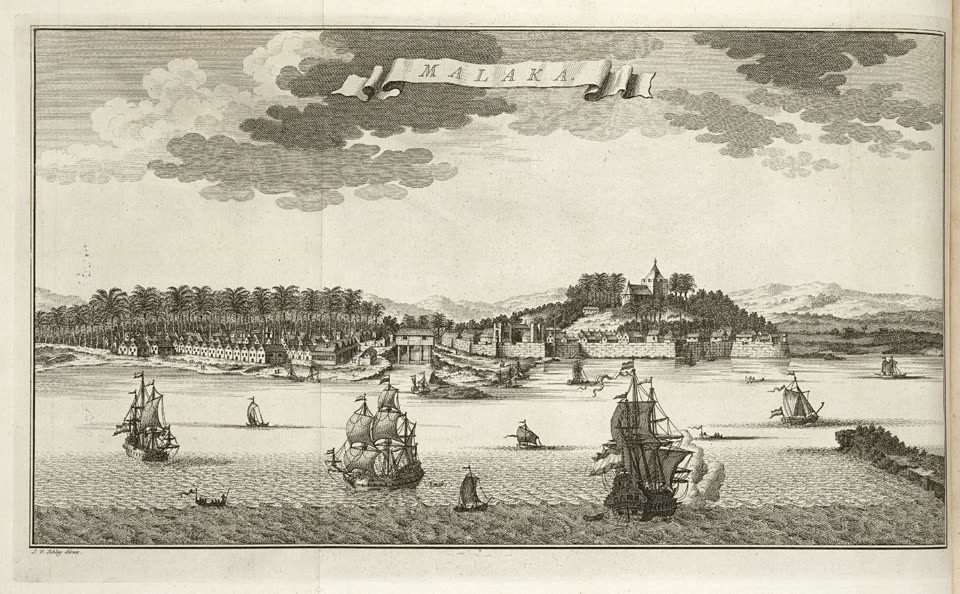
But if what we are telling is the story of Melaka's founder, Singapura cannot be set aside. Whether one follows the Malay Annals or the Portuguese tradition, the story of Melaka does not begin in Melaka — it begins along a line of flight: Palembang, Temasek / Singapura, Muar, and finally Sungai Bertam. 1,6
Moreover, fourteenth-century Singapura was not an empty tract of ground. Archaeological work shows that the fourteenth-century deposits around the Singapore River mouth, Bukit Larangan (Fort Canning), and the Empress Place area have yielded abundant Chinese ceramics, coins, and glass objects — evidence that the site was already a port settlement connected to long-distance trade. 8,3
In other words, what Raja Secander Shah fled was not a nameless backwater.
What he fled was a node in the maritime world of the strait — a place with trade, with political standing, and with external pressures bearing down upon it.
Melaka's later rise was possible precisely because it inherited the logic of that world: whoever controls the harbour, whoever draws the ships, whoever understands how to find shelter between great powers — that is who has a chance to survive.
The next time, he would no longer be merely a fugitive.
He would begin to receive envoys from China, and the court stories would in time arrange for him a Chinese princess. But that princess — in the archives of the Ming dynasty — does not exist in a single written word.
Sources 8 Every important claim here can be checked. Open it and see.
Do not trust this site. Check it — every source below is clickable.
-
Search for this source ⌕ no direct link — this button searches for the work 2026-07-30 Report this source
-
Search for this source ⌕ no direct link — this button searches for the work 2026-07-30 Report this source
This site is written with AI assistance. Please check us.
AI can invent citations that look completely convincing — a real author's name, a plausible title, a sensible year, for a work that does not exist. This is not a theoretical risk; it is a known failure mode. That is why every source on this site is clickable. If a reference cannot be found anywhere, it may well not exist — and we want to know.
How to check us →
Reader Comments
Be the first to share your thoughts.